
Quick answer
In the wild, axolotls face three main predator categories: large wading birds (herons, egrets, storks), invasive fish (Nile tilapia and common carp), and aquatic insects (water beetles, dragonfly larvae). The invasive fish are by far the most damaging — tilapia alone now comprises approximately 95% of the animal mass in Xochimilco canals. Wild axolotls are nocturnal and spend days burrowed in sediment or vegetation to avoid predators. In captivity, the main threats are inappropriate tank mates and larger axolotls.
- Main wild predators: herons, egrets, storks, Nile tilapia, common carp, aquatic insects
- Most damaging: Nile tilapia (95% of canal animal mass) — eats eggs and juveniles
- Wild predator avoidance: nocturnal activity, burrowing, vegetation cover, camouflage coloration, turbid-water preference
- Captive threats: inappropriate tank mates; no true wild predators in a proper tank
- Predation pressure causes reduced activity → less foraging and mating → compounds population decline
Wild Predators of the Axolotl
Birds — Herons, Egrets, and Storks
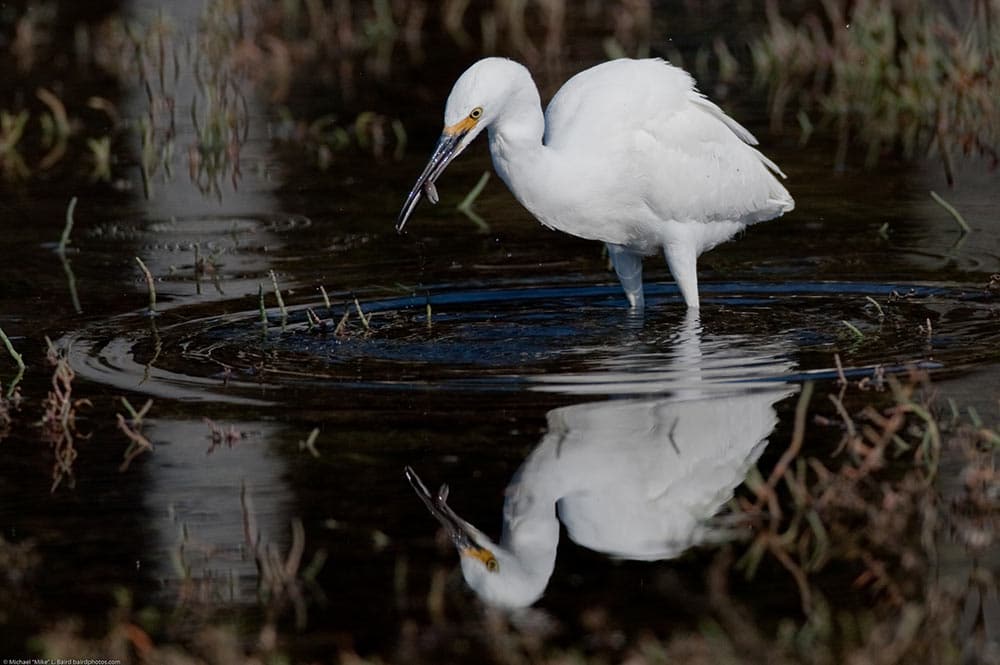
Large wading birds are natural predators of axolotls in the Xochimilco canal system. Herons (including the grey heron and great blue heron) and egrets (particularly the great egret) wade or stand in shallow water, hunting visually for movement below the surface. A wild axolotl near the surface during daylight hours is an easy target.
Storks are also active in the Xochimilco habitat and opportunistically prey on axolotls.
The 2025 axolotl reintroduction study documented released captive-bred axolotls being preyed upon by great egrets in semi-protected release conditions — confirming this threat is active and significant even in managed environments.
Invasive Fish — The Primary Threat
The most damaging predators of wild axolotls are two fish species introduced to Xochimilco in the 1970s and 1980s:
Nile tilapia (Oreochromis niloticus) preys primarily on axolotl eggs and juveniles. Tilapia has become so dominant in Xochimilco that it now comprises approximately 95% of the canal system’s total animal mass. Researchers collected approximately 600 kilograms of tilapia in a single 100-meter net sweep of one small channel.
Common carp (Cyprinus carpio) targets primarily axolotl eggs and competes with axolotls for food sources.
The introduction of these species — originally for food production — transformed Xochimilco from a habitat where axolotls were apex benthic predators into one where they’re hunted at their most vulnerable life stages by a dominant invasive species.
Aquatic Insects — Natural Secondary Predators
Natural aquatic predators of axolotl eggs and larvae include water beetles (aquatic Coleoptera) and dragonfly larvae (Odonata). These are endemic predators that have always been part of the Xochimilco ecosystem. Unlike the invasive fish, they don’t threaten axolotl population viability at scale — they’re a normal component of the natural predation pressure against which axolotl reproductive strategy (large clutch size) has evolved.
Tiger Salamanders — Sympatric Competitor
Ambystoma tigrinum (tiger salamander) naturally occurs in the same habitat as the axolotl and is capable of predating on axolotl juveniles. Tiger salamanders can metamorphose and exploit both aquatic and terrestrial environments, giving them more behavioral flexibility.
How Axolotls Avoid Predators in the Wild
Nocturnal Activity
Wild axolotls hunt primarily at night. During the day, they remain hidden in sediment or vegetation — dramatically reducing exposure to herons and egrets that hunt visually in daylight.
Burrowing
Axolotls burrow into sediment and hide among benthic vegetation. This provides concealment from above-surface predators and reduces detection by fish moving through open water.
Vegetation Cover
Dense aquatic vegetation provides shelter and visual cover. This is one reason eutrophication in Xochimilco canals is so damaging — it destroys aquatic plant communities, eliminating the cover axolotls depend on.
Camouflage Coloration
The dark brown-grey coloration with irregular spots of wild axolotls closely resembles the muddy, vegetated lake floor. When still, a wild-type axolotl blends into the bottom effectively.
This is why pale captive morphs (leucistic, albino, golden albino) don’t exist in the wild — a white animal in dark muddy water would be immediately visible to bird predators. Pale morphs are products of captive selective breeding where predation pressure doesn’t exist. For full morph information, see axolotl colors.
Turbidity Preference — Water Murkiness as Camouflage
Research by Luis Zambrano at UNAM found that axolotls prefer turbid (murky) water over clear water. The explanation: turbid water limits visibility for bird predators hunting from above. In clear water, an axolotl on the bottom is visible from the surface; in turbid water, it’s effectively hidden. This preference appears to be an adaptive response shaped over millions of years of avian predation pressure in Xochimilco.
How Predation Affects the Wild Population Beyond Direct Kills
Tilapia predation doesn’t just remove individual axolotls — it changes their behavior. Axolotls in areas with high tilapia density are less active: they reduce movement, foraging, and surface time to minimize predation risk.
The population-level cost: reduced activity = reduced mating. An axolotl staying hidden to avoid tilapia is also not engaging in courtship behaviors. This behavioral suppression of mating directly reduces reproductive output beyond direct predation on eggs and juveniles.
Zambrano’s research suggests that reducing tilapia predation pressure — even in small protected zones — could allow axolotl activity and mating to recover. This is the core ecological rationale for the Refugio Chinampa approach of creating tilapia-excluded canal zones.
For full conservation context, see why is the axolotl endangered.
Captive Tank — What Threatens Axolotls in Tanks
Axolotls in a properly maintained home tank face no natural predators. The risks come from housing choices:
Aggressive or inappropriately sized fish: Medium-to-large fish can nip at gill filaments or attempt to eat smaller axolotls. Small fish will be eaten by the axolotl; large aggressive fish will harm it. General rule: axolotls should be housed alone or only with very small, docile fish that won’t nip gills.
Crayfish: Crayfish claws cause serious wounds. Never cohabitate.
Larger axolotls: Axolotl cannibalism is well-documented when animals of significantly different sizes are housed together. A larger axolotl will bite a smaller one, particularly at feeding time.
Turtles: Turtles will bite axolotls. Not compatible.
For full guidance, see axolotl tank mates.
Frequently Asked Questions
Does this article cover threats to pet axolotls, or only wild axolotl predation?
Wild predation ecology only. For tank-mate safety in captivity, see axolotl tank mates guide and can axolotls live with fish.
Is cannibalism between captive axolotls covered here?
Briefly referenced in the context of wild juvenile predation. Captive cannibalism risk management — size separation, feeding frequency, housing rules — is in axolotl cannibalism prevention.
Does this article overlap with the endangered article’s coverage of invasive fish?
Why is the axolotl endangered covers invasive species as a systemic conservation threat. This article covers predation ecology specifically — how tilapia and carp interact with axolotls as predators, and the scale of their impact.
Does this article explain why pale captive morphs wouldn’t survive in the wild?
Yes — wild-type camouflage versus captive morph visibility is discussed here. For the genetics behind pale morph coloration, see axolotl colors.
This content is for educational purposes only. Wild axolotl ecology is an active research area; specific predation data from the 2025 reintroduction study is preliminary and subject to future publications.