
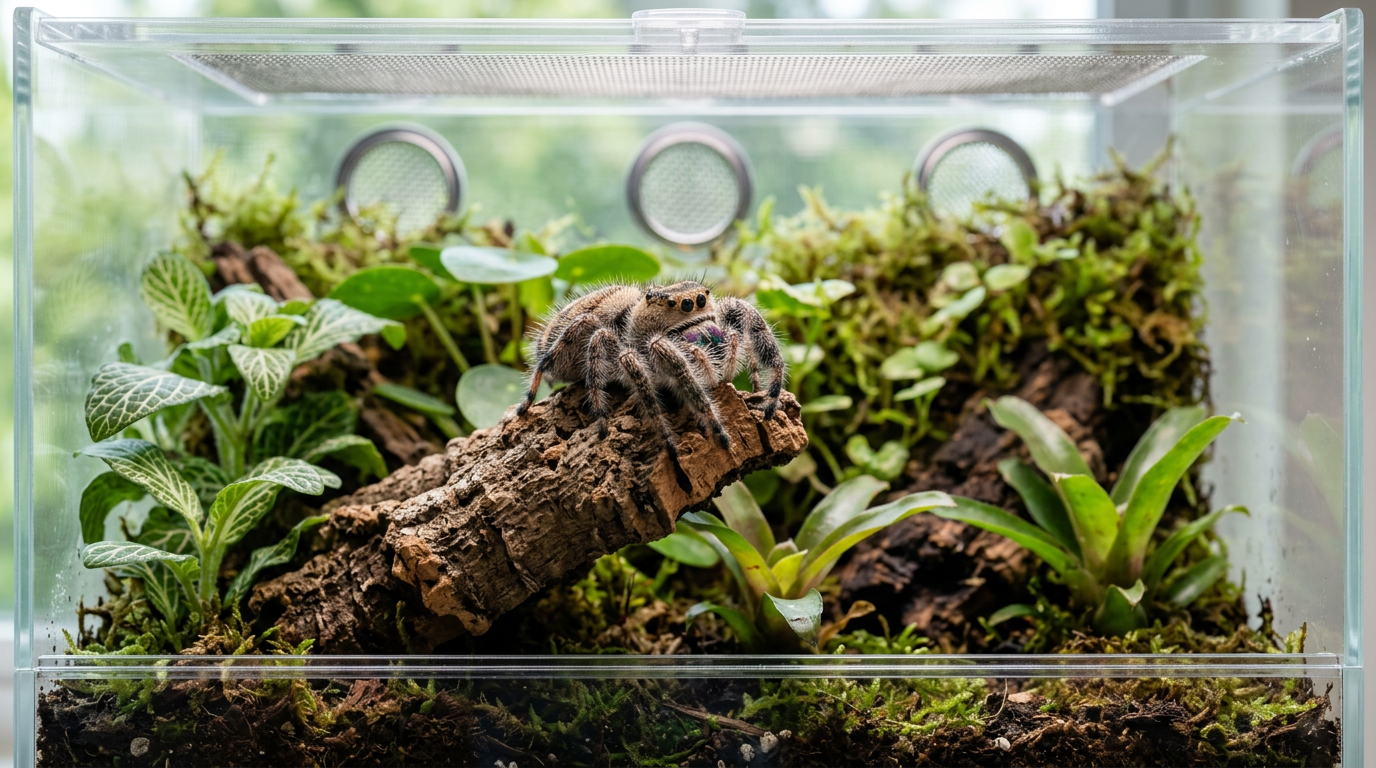
Jumping spiders are the most visually dependent hunters in the entire arachnid world. Their oversized anterior median eyes provide color vision, depth perception, and some of the sharpest visual acuity of any arthropod relative to body size (source: National Geographic). Light drives nearly everything a jumping spider does: hunting, navigation, courtship recognition, and daily activity cycles. Despite this heavy reliance on light, jumping spiders do not need specialized lighting equipment in most home setups. Ambient room light or indirect natural light from a nearby window provides everything the spider requires. This guide explains what kind of light jumping spiders actually need, why the UVB debate exists, how to set up a proper light cycle, and the specific situations where supplemental lighting makes sense.
What kind of light do jumping spiders need?
Jumping spiders need a consistent day-night cycle with bright-enough daytime light to support their hunting behavior. In the wild, jumping spiders are diurnal hunters. They are active during daylight hours, using their exceptional vision to stalk and pounce on prey. At night, they retreat to silk hammocks and rest. This photoperiod drives their metabolism, feeding behavior, and molting cycles.
The light itself does not need to be anything special. Standard indoor ambient light from ceiling fixtures, desk lamps, or window light is sufficient for a jumping spider to see, hunt, and behave normally. The spider does not require a dedicated enclosure light the way a bearded dragon or chameleon does, because jumping spiders do not bask and do not depend on light for thermoregulation or vitamin synthesis in the same way reptiles do.
What matters is consistency and contrast. The spider needs a clear difference between “daytime” (bright, active period) and “nighttime” (dark, resting period). A room that stays lit 24 hours a day disrupts the spider’s rest cycle. A room that stays dark most of the day suppresses hunting activity and may reduce feeding response.
How long should the light cycle be for a jumping spider?
A 12-hour light and 12-hour dark cycle works well for the vast majority of pet jumping spider species. This matches the approximate equatorial photoperiod that most commonly kept species (Phidippus regius, Phidippus audax, Hyllus diardi) evolved under. Some keepers adjust to a 14-hour light and 10-hour dark schedule during warmer months and reverse it slightly in cooler months to mimic seasonal variation, but this is optional and most spiders thrive on a steady 12/12 cycle year-round (source: The Tarantula Collective).
If your jumping spider’s enclosure is in a room with consistent daily schedules (lights on in the morning, off at bedtime), the room’s normal pattern probably provides an adequate cycle without any additional setup. Problems arise when the enclosure is in a room that stays lit late into the night (a home office with overhead lights on until midnight, a living room with a television providing flickering light after dark) or in a room that gets very little natural light during the day (a basement or interior room with no windows).
Signs that the light cycle needs adjustment
A jumping spider that hides in its web hammock during what should be active daytime hours and only emerges at night may be responding to insufficient daytime light. A spider that never settles into its hammock and seems restless at all hours may be experiencing too much nighttime light disruption. These behavioral shifts are subtle and can overlap with other stress causes (temperature, enclosure size, recent relocation), so rule out other factors before attributing the behavior to lighting alone. The behavior guide covers baseline activity patterns in more detail.
Do jumping spiders need UVB light?
This is the most debated lighting question in the jumping spider hobby, and the short answer is: there is no scientific evidence that pet jumping spiders require UVB lighting for health. Unlike reptiles that synthesize vitamin D3 through UVB-driven skin chemistry and suffer metabolic bone disease without it, jumping spiders obtain their nutritional requirements entirely through prey consumption. Their exoskeletons are chitinous, not calcium-based bone, and their vitamin D pathway does not depend on UV exposure.
That said, some keepers report anecdotal improvements in activity level and coloration when providing low-level UVB or full-spectrum lighting. The mechanism behind these observations is unclear. It may be that full-spectrum bulbs simply produce a broader, more natural light spectrum that improves the spider’s visual environment and stimulates more natural behavior, rather than the UVB wavelength specifically providing a physiological benefit.
If you want to try UVB or full-spectrum lighting
Use a low-output UVB bulb (2.0 or 5.0 rated, not the high-output 10.0 or 12.0 bulbs designed for desert reptiles). Mount it outside the enclosure mesh, never inside where the spider can contact it. Maintain the same 12-hour on/off cycle as standard lighting. Monitor the spider’s behavior for 2 to 4 weeks. If you see no behavioral change, the bulb is not providing a meaningful benefit for your specific spider.
Do not use UVB lighting as a substitute for proper diet. A well-fed jumping spider eating gut-loaded feeder insects gets everything it needs nutritionally from its prey. The complete diet guide covers feeder nutrition in detail.
What types of lights work best for jumping spider enclosures?
Indirect natural light from a window is the simplest and most effective lighting solution. Place the enclosure near (but not directly in) a window that receives daylight. Direct sunlight hitting the enclosure creates a greenhouse effect that can overheat the small airspace rapidly, potentially killing the spider within hours. Filtered or indirect light from several feet away from the window provides bright, full-spectrum illumination without heat risk.
LED desk lamps or strip lights work well for enclosures in rooms with insufficient natural light. Use a white or daylight-temperature LED (5000K to 6500K color temperature) positioned above or beside the enclosure. LED lights produce minimal heat, which is important for small enclosures where even a few degrees of warming matters. Place the light outside the enclosure, not inside.
Standard room lighting (ceiling fixtures, floor lamps) provides adequate illumination for jumping spiders in most home environments. If you can read a book comfortably in the room, the light level is sufficient for the spider’s visual needs.
Lights to avoid
Incandescent bulbs and halogen spots produce significant heat relative to their light output. Placing one near a small jumping spider enclosure risks overheating the interior. The temperature and humidity guide covers the target range (75 to 85 degrees Fahrenheit for most species) and explains why temperature stability matters.
Colored or novelty lights (red, blue, blacklight) alter the light spectrum in ways that may interfere with the spider’s color vision and prey-detection behavior. Red lights are sometimes marketed as “nighttime viewing” lights for reptiles, but jumping spiders have tetrachromatic vision that extends into the UVA range, meaning they can likely perceive light wavelengths that humans cannot see. A “dark” red or blue light may not appear dark to the spider (source: Current Biology, jumping spider UV vision research).
Heat lamps or ceramic heat emitters are designed for reptile basking setups and have no place in a jumping spider enclosure. They produce dangerous heat levels for a small arboreal invertebrate enclosure and provide no benefit.
Should you use a timer for the light cycle?
A timer is the most reliable way to maintain a consistent photoperiod if the enclosure relies on a dedicated light source rather than ambient room light. Plug-in mechanical timers or smart-outlet timers set to turn the light on and off at the same time each day prevent the photoperiod from drifting as your personal schedule changes.
If the enclosure is in a room where you naturally turn lights on and off at consistent times (bedroom, home office), a dedicated timer is optional. The room’s rhythm provides the cycle. If the enclosure is in a room with irregular lighting patterns, a timer removes the guesswork.
Set the timer for 12 hours on and 12 hours off, aligning the “on” period with daytime if possible. The spider does not care whether the lights come on at 7 AM or 10 AM, but consistency matters more than the specific start time.
Does nighttime darkness matter for jumping spiders?
Yes. Jumping spiders need a dark resting period to complete their daily cycle. During darkness, the spider retreats to its silk hammock, reduces activity, and rests. This period is functionally equivalent to sleep in vertebrates, though the neuroscience is different.
Research on jumping spider sleep behavior has documented REM-like states in Evarcha arcuata spiderlings, with leg twitching and eye-tube movements during nighttime rest periods that resemble sleep stages seen in mammals and birds (source: PNAS, Daniela Roessler et al., 2022). This finding suggests that uninterrupted darkness is important not just for behavioral rest but for neurological processes.
Keep the enclosure in a location where nighttime light exposure is minimal. If the room has standby LEDs on electronics, television glow, or streetlight coming through windows, position the enclosure away from these light sources or use a light-blocking cover during the dark period. A simple cloth draped over the enclosure (ensuring ventilation is not blocked) works.
Frequently asked questions
Can jumping spiders live in a dark room?
They can survive, but they will not thrive. Jumping spiders are visual hunters. In a consistently dark environment, they cannot hunt effectively, their activity levels drop, and their natural behavior patterns break down. Even a dim room with some indirect light is significantly better than a dark one. If the enclosure must be in a low-light room, add a simple LED light on a 12-hour timer.
Will a bright light stress my jumping spider?
Jumping spiders are diurnal and evolved in well-lit environments, so bright light during the day does not stress them the way it would stress a nocturnal species. However, light combined with heat is a problem. If a light source heats the enclosure above the safe temperature range, the heat is the stressor, not the brightness itself. Check the enclosure temperature with a thermometer any time you add or change a light source.
Do jumping spiders see in the dark?
Their vision is poor in darkness. The large anterior median eyes that provide their exceptional daytime vision rely on light. In complete darkness, jumping spiders navigate primarily by touch and vibration rather than sight. Their secondary eyes (the three pairs of smaller lateral and posterior eyes) detect motion and light changes but do not provide detailed images. This is why they retreat and rest at night rather than hunting.
Should spiderlings have the same lighting as adults?
Yes. Spiderlings benefit from the same 12-hour light and 12-hour dark cycle. They are active hunters from their first instar and need light to locate prey (typically flightless fruit flies or springtails). No special lighting adjustments are needed for different life stages. The feeding schedule guide covers spiderling-specific feeding frequency.
Researched and written by the ExoPetGuides editorial team with AI-assisted drafting. All husbandry parameters and veterinary references independently verified against peer-reviewed sources.
Disclaimer: This content is for educational purposes only and is not a substitute for professional veterinary advice. Always consult a qualified veterinarian for any health concern about your pet. Care recommendations may vary based on species, individual animal, and local regulations.


