
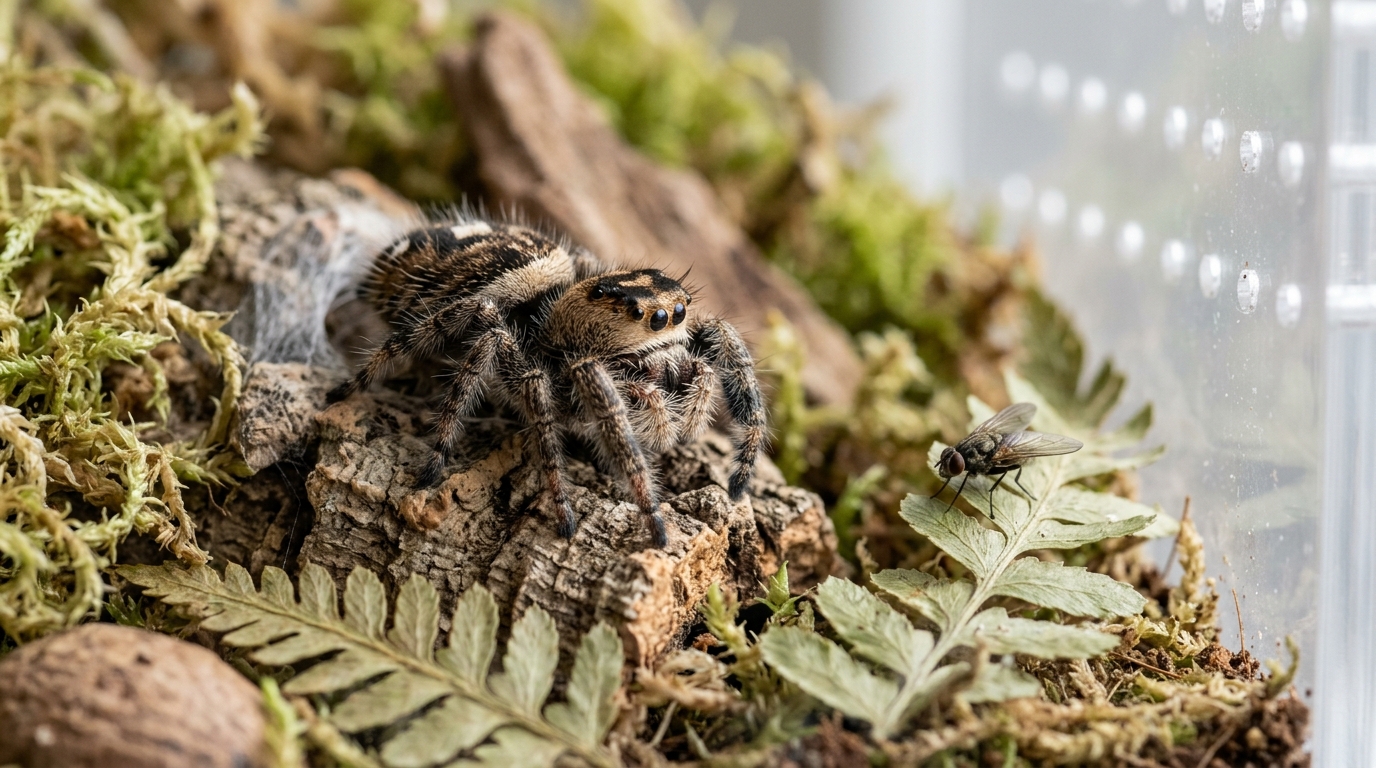
A jumping spider that stops eating is one of the most common concerns new keepers face, and in most cases the cause is entirely benign. Pre-molt fasting accounts for the majority of appetite pauses in healthy spiders. The spider stops eating, hides in its web hammock, and emerges a few days later in a fresh exoskeleton with its appetite restored. But a spider that refuses food for an extended period outside of a molt, combined with behavioral changes or environmental problems, may be signaling something that needs intervention. This guide walks through every common cause of appetite loss in order of likelihood, explains how to distinguish normal fasting from genuine problems, and provides specific solutions for each scenario.
Is your jumping spider about to molt?
Pre-molt fasting is the single most common reason a jumping spider stops eating. Before every molt, the spider’s body redirects energy from digestion to the physiological process of building a new exoskeleton beneath the old one. Eating during this phase would be counterproductive and potentially dangerous, as prey in the digestive tract could complicate the molt.
How to recognize pre-molt fasting
The signs are consistent and predictable:
- The spider retreats to its web hammock and stays there for extended periods.
- It refuses food that it would normally accept eagerly.
- The abdomen may appear darker or duller than usual as the new exoskeleton develops underneath.
- Activity levels drop. The spider may sit in one place for hours.
- In some species, the eye area appears darker or more opaque just before a molt.
Pre-molt fasting duration by life stage: Spiderlings fast for 1 to 3 days before molting. Juveniles fast for 3 to 5 days. Sub-adults approaching their penultimate or ultimate molt may fast for 5 to 10 days. These ranges are normal and expected (source: The Tarantula Collective).
What to do: Nothing. Remove any live prey from the enclosure (crickets left with a molting spider can injure it), ensure humidity is adequate by misting one wall lightly, and leave the spider undisturbed. Do not open the enclosure repeatedly to check on it. Do not attempt to offer food. The spider will eat when it is ready, typically 24 to 48 hours after completing the molt. The feeding schedule guide covers pre-molt fasting timelines in more detail.
Is the enclosure temperature too low?
Jumping spiders are ectotherms. Their metabolic rate, activity level, and appetite are directly tied to ambient temperature. When the enclosure temperature drops below approximately 70 degrees Fahrenheit, most species become sluggish and lose interest in food. Below 65 degrees Fahrenheit, some spiders stop eating entirely and enter a state of reduced activity that resembles dormancy (source: Arachnoboards).
How to check
Place a small digital thermometer inside the enclosure or use an infrared temperature gun to read the surface temperature of the enclosure walls. The target range for most pet jumping spider species is 75 to 85 degrees Fahrenheit (24 to 29 degrees Celsius). Phidippus regius and Phidippus audax tolerate the lower end of this range. Hyllus diardi prefers the upper end.
How to fix
Move the enclosure to a warmer room. If room temperature cannot be raised, place a small heat mat on one side of the enclosure (never underneath, which can overheat the floor and the spider has no way to escape the heat) set to maintain the target range. Use a thermostat to prevent overheating. Avoid heat lamps and ceramic heat emitters, which produce dangerous localized heat in small enclosures. The temperature and humidity guide covers heating solutions in full.
Once the temperature stabilizes in the target range, appetite typically returns within 24 to 48 hours.
Is the prey the wrong size or type?
Prey that is too large intimidates the spider rather than triggering a hunting response. Prey that is too small may not register as worth pursuing. Prey that the spider has never encountered before may be rejected simply because it does not match the spider’s learned hunting pattern.
Size problems
If the spider backs away from offered prey, raises its front legs in a defensive posture toward the prey, or retreats to its hammock when the prey is introduced, the feeder is likely too large. Reduce prey size. The feeder should be no longer than the spider’s body length (cephalothorax plus abdomen, excluding legs). The diet guide provides detailed sizing tables.
If the spider watches tiny prey walk past without reacting, the feeder may be too small to trigger a hunting response. Try a slightly larger option or a faster-moving species (fruit flies move more erratically than mealworms, which may help catch the spider’s attention).
Type preferences
Individual jumping spiders develop prey preferences. A spider raised exclusively on fruit flies may initially refuse crickets because the shape, movement pattern, and size are unfamiliar. Introduce new feeder types gradually. Offer the new feeder when the spider is at the hungrier end of its feeding cycle (day 4 or 5 for an adult, rather than day 2) so motivation is higher. If the spider still refuses, try a different feeder type rather than forcing the same one repeatedly. The feeder insects guide covers the full range of options.
Is the spider dehydrated?
Dehydration suppresses appetite in jumping spiders. A dehydrated spider prioritizes water intake over food, and severe dehydration causes lethargy that makes hunting impossible. Dehydration is especially common in enclosures with excessive ventilation (too much mesh, fan blowing near the enclosure) or in dry climates where ambient humidity is below 40 percent.
Signs of dehydration
- Wrinkled or shriveled abdomen
- Reduced activity and slow movements
- Spider sitting low in the enclosure near the substrate (unusual for an arboreal spider that normally perches high)
- Spider pressing its chelicerae against the enclosure walls (looking for water droplets)
How to fix
Mist one wall of the enclosure immediately to create drinking droplets. If the spider appears severely dehydrated (immobile, legs partially curled), place a small water droplet directly in front of the spider using a pipette or spray bottle. Most dehydrated jumping spiders drink immediately when water is presented.
After rehydrating, the spider may take 12 to 24 hours before appetite returns. Ensure the enclosure misting schedule maintains adequate humidity going forward. The temperature and humidity guide covers misting frequency and the humidity gradient approach.
Is the spider stressed from a recent change?
Jumping spiders are sensitive to environmental changes. A recently purchased spider, a spider moved to a new enclosure, or a spider whose enclosure was significantly rearranged may refuse food for several days while it acclimates to the new surroundings. This stress-related appetite suppression is temporary.
Common stress triggers that suppress appetite
- New arrival: A spider shipped through the mail or purchased from a store may refuse food for 3 to 7 days after arriving in its new home. Shipping stress, temperature fluctuations during transit, and an unfamiliar enclosure all contribute.
- Enclosure change or deep clean: Moving the spider to a new enclosure or performing a thorough clean that removes the web hammock forces the spider to re-establish its territory. Appetite may dip for 1 to 3 days. The enclosure cleaning guide covers minimizing cleaning-related stress.
- Excessive handling: Jumping spiders that are handled too frequently or for too long can become stressed. Signs include hiding for extended periods after being returned to the enclosure and refusing food the same day. Reduce handling frequency if appetite drops after handling sessions.
- Vibration and noise: Enclosures placed near speakers, washing machines, or frequently slammed doors experience vibration that jumping spiders detect through their sensitive leg hairs. Chronic vibration is a subtle but real stressor.
How to fix
Minimize disturbance. Place the enclosure in a quiet, stable location. Do not handle the spider. Offer food every 2 to 3 days but remove uneaten prey promptly. Most spiders resume eating within 3 to 7 days once the stress source is removed or the spider has acclimated.
Is there enough light for the spider to hunt?
Jumping spiders are visual hunters that depend on adequate light to locate, stalk, and pounce on prey. An enclosure in a dark room, a basement, or a corner that receives little natural or artificial light may leave the spider unable to see prey clearly enough to trigger its hunting sequence.
If the spider was eating normally and stopped after the enclosure was moved to a darker location, or if the feeding refusal coincides with shorter winter daylight hours, insufficient light may be the factor. Provide a consistent 12-hour light cycle using ambient room light or a simple LED light. The lighting guide covers optimal light conditions for jumping spider enclosures.
Could the spider be sick?
Illness is the least common cause of appetite loss in jumping spiders, but it should be considered when all environmental factors have been ruled out and the spider has not eaten for an extended period.
Warning signs that suggest illness rather than normal fasting
- Appetite loss lasting more than 10 days in an adult (outside of pre-molt) with no environmental explanation.
- Lethargy or unresponsiveness. A spider that does not react to prey placed directly in its field of vision, or that does not respond to gentle disturbance, may be seriously ill.
- Physical changes: discolored patches on the abdomen, visible mites on the body or legs, fungal growth (white fuzzy patches), fluid leaking from the abdomen or chelicerae, legs curling inward.
- Abdomen shrinking progressively despite food being available. This suggests the spider is losing body mass from an internal cause.
What to do
There are no home treatments for most jumping spider illnesses. If you suspect illness after ruling out pre-molt, temperature, dehydration, stress, and prey issues, the best course of action is to ensure optimal enclosure conditions (clean, proper temperature, proper humidity, adequate ventilation) and offer food regularly. Some spiders recover with environmental optimization alone. For visible parasites (mites), isolate the spider in a clean temporary enclosure and consult an exotic-animal veterinarian if the infestation does not resolve with enclosure cleaning.
Invertebrate veterinary medicine is limited, and most general-practice veterinarians do not treat jumping spiders. If you can locate an exotic-animal or invertebrate specialist, they can provide more targeted advice.
Diagnostic flowchart: why is my jumping spider not eating?
Work through the following sequence when your spider refuses food:
Check for pre-molt signs. Is the spider hiding in its hammock? Is the abdomen dark or dull? Has it been 1 to 10 days since the last meal (depending on age)? If yes, wait. This is almost certainly a molt.
Check temperature. Is the enclosure below 70 degrees Fahrenheit? If yes, warm the enclosure and recheck appetite in 24 to 48 hours.
Check hydration. Is the abdomen wrinkled? When did you last mist? If dehydration is possible, mist immediately and wait 12 to 24 hours.
Check prey size and type. Is the prey appropriate for the spider’s body size? Has the spider eaten this prey type before? Try a different size or species.
Check for recent stress. Is the spider a new arrival? Was the enclosure recently cleaned or moved? Reduce disturbance and try again in 2 to 3 days.
Check lighting. Is the enclosure getting adequate daytime light? Add light if needed and recheck.
Check for illness signs. If steps 1 through 6 do not explain the refusal and the spider has not eaten for more than 10 days, monitor for physical illness signs and optimize all environmental conditions.
Frequently asked questions
How long can a jumping spider go without eating before it is dangerous?
A healthy adult jumping spider can survive 1 to 2 weeks without food under normal conditions. Spiderlings have smaller energy reserves and should not go more than 3 to 4 days without eating outside of a pre-molt period. If an adult has not eaten for 2 weeks and shows no pre-molt signs, something is wrong and you should work through the diagnostic sequence above.
Should I try to force-feed my jumping spider?
No. Force-feeding a jumping spider is extremely difficult, carries a high injury risk to the spider, and is almost never necessary. If the spider is refusing food, the correct approach is to identify and fix the underlying cause. The spider will eat when the cause is resolved. The only scenario where assisted feeding might be considered is a severely emaciated spider that is too weak to hunt, and even then, placing a pre-killed prey item directly against the chelicerae (without restraining the spider) is the limit of what can be done safely at home.
My spider ate last week but refused food today. Is that normal?
Yes. Jumping spiders do not eat on a rigid schedule. A spider that ate 3 days ago may refuse food today because it is still digesting, is in early pre-molt, is slightly dehydrated, or simply is not hungry. Try again in 1 to 2 days. A single refused meal is not a cause for concern.
Does the time of day matter when offering food?
Yes. Jumping spiders are diurnal, meaning they are most active and most likely to hunt during daylight hours. Offering prey in the morning or early afternoon aligns with the spider’s natural activity peak. Offering food late at night when the spider has retreated to its hammock usually results in refusal, not because anything is wrong, but because the spider is resting.
My jumping spider catches prey but does not eat it. What does this mean?
A spider that pounces on prey, wraps it in silk, but then abandons it without feeding may be exhibiting surplus killing (hunting behavior triggered by movement but without hunger motivation) or may have caught prey that it finds unpalatable. This can also happen with feeders that have been dead for a while before being offered, as decomposition changes the taste. Offer fresh, live prey at the next scheduled feeding and observe whether the spider consumes it fully.
Researched and written by the ExoPetGuides editorial team with AI-assisted drafting. All husbandry parameters and veterinary references independently verified against peer-reviewed sources.
Disclaimer: This content is for educational purposes only and is not a substitute for professional veterinary advice. Always consult a qualified veterinarian for any health concern about your pet. Care recommendations may vary based on species, individual animal, and local regulations.

![Do hedgehog smell? [Hedgehog Bath and Grooming Guide]](https://petsforchildren.com/wp-content/uploads/2026/04/do-hedgehog-smell-hedgehog-bath-and-grooming-guide-370x297.jpg "Do hedgehog smell? [Hedgehog Bath and Grooming Guide]")