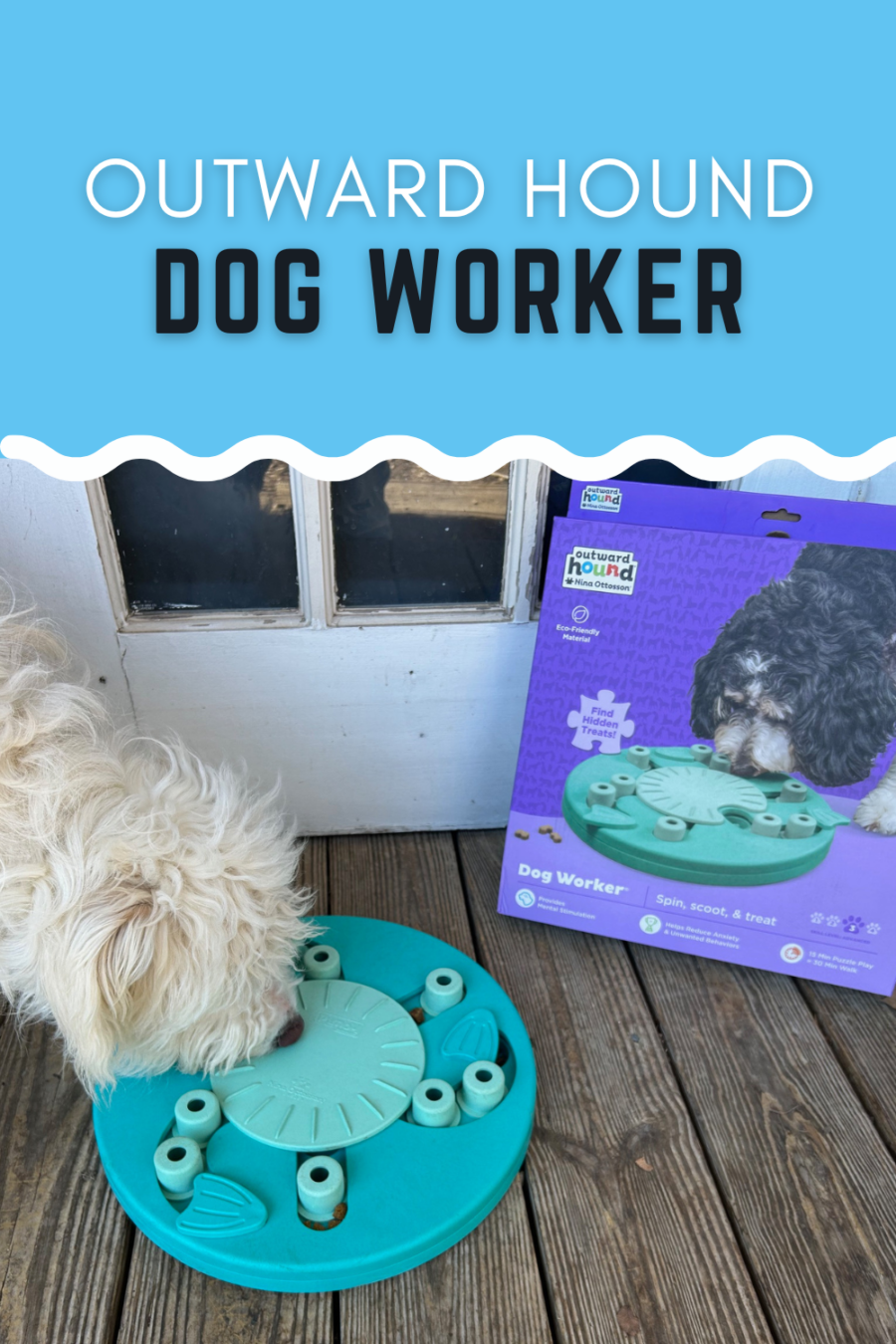
If you’re looking for a dog toy that really makes your pup think, the Outward Hound Nina Ottosson Dog Worker puzzle is a real challenge. This interactive puzzle engages your dog’s brain in ways simple chew toys and fetch balls never can — and that matters for your dog’s well-being.
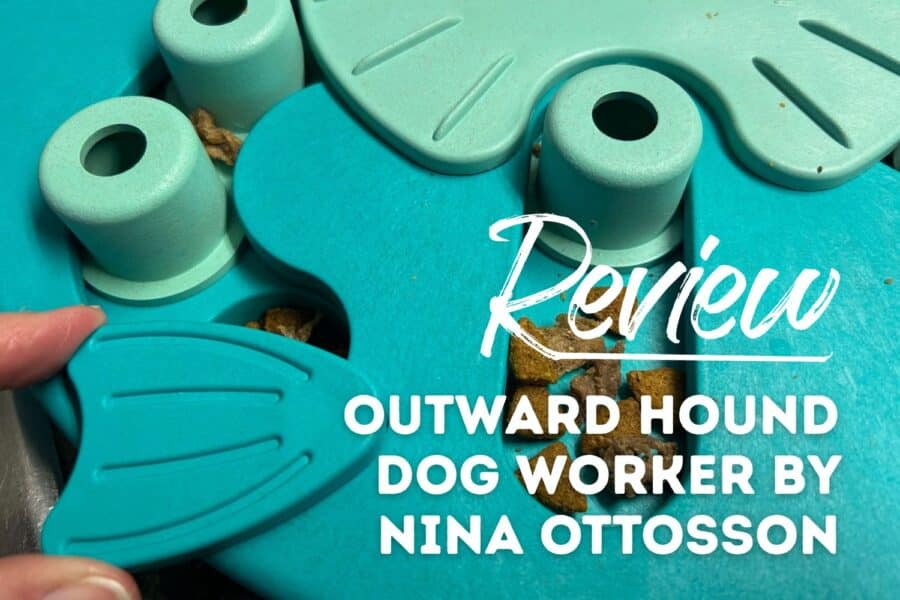
Dogs can use enrichment toys like the Dog Walker to engage their natural instincts to search, sniff, problem-solve, and forage. You can use the toy to prolong the fun of meal time or treat time.
I recently purchased a Dog Worker to try out with Barli and Isla. I already have (and love) the very similar looking Hide ‘n Slide toy but I wanted to increase the difficulty level. The Dog Worker is a Level Three (out of four) difficulty level while the Hide ‘n Slide is a Level Two.
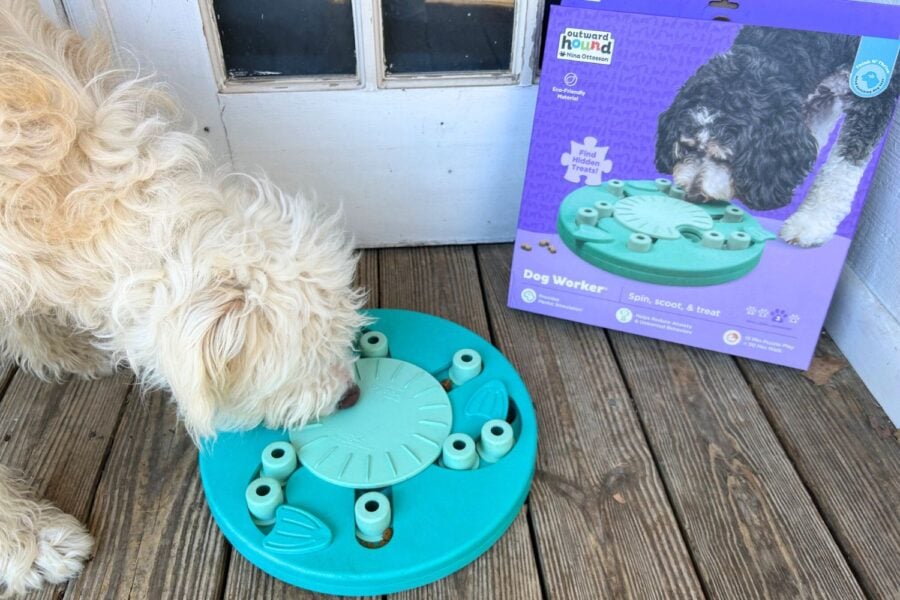
Here’s how it works:
- You’ll drop small treats, kibble or other high-value (dry) treats into the puzzle.
- Your dog will push flippers to allow blocks to slide, unveiling recessed compartments where treats are hidden.
- Your dog can spin the center (removable) wheel to open and close the tracks.
Let’s look at how you can use the Dog Worker with your dog–and some ways to make it easier or more difficult as your dog gets more experienced!
The Nina Ottosson Line of Toys
Nina Ottosson is a Swedish designer and the creator of one of the most well-known lines of interactive dog (and cat) puzzle toys on the market, sold by Outward Hound. She started developing puzzle games for dogs decades ago, originally to mentally stimulate her own dogs in fun, engaging ways — and those early designs eventually grew into an entire category of brain-challenging enrichment toys.
Her puzzles require dogs to lift, slide, spin, or uncover hidden treats, tapping into instinctive behaviors like searching and foraging. This makes the challenge feel meaningful rather than random.
Ottosson’s central philosophy is that dogs need both physical and mental activity — “the dog has four legs and one head, and all five need activity in different ways.”
How to Use the Dog Worker
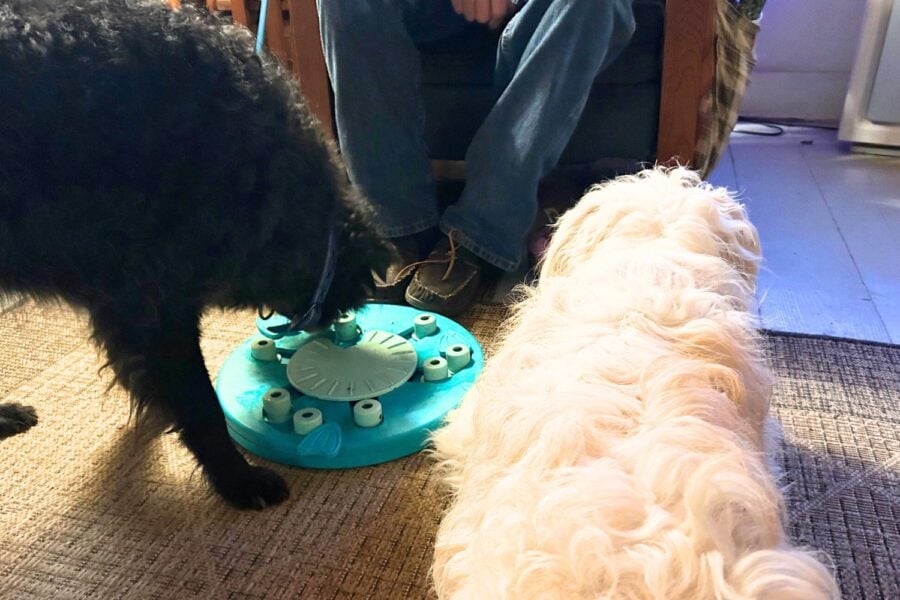
If your dog is new to puzzles, you might need to sit with your dog and show him how to retrieve the treats the first few times. And that’s a big part of enrichment: creating an experience you and your dog can enjoy together!
Not all dogs instantly understand how puzzles work — especially if they’ve never had interactive toys before. Here are some ways to set your pup up for success:
Start with Introductions
- Place high-value treats partially visible so they see how it works. Later you can use the toy to feed a portion of your dog’s daily kibble but, during this introductory phase, use strong-smelling treats to motivate your dog.
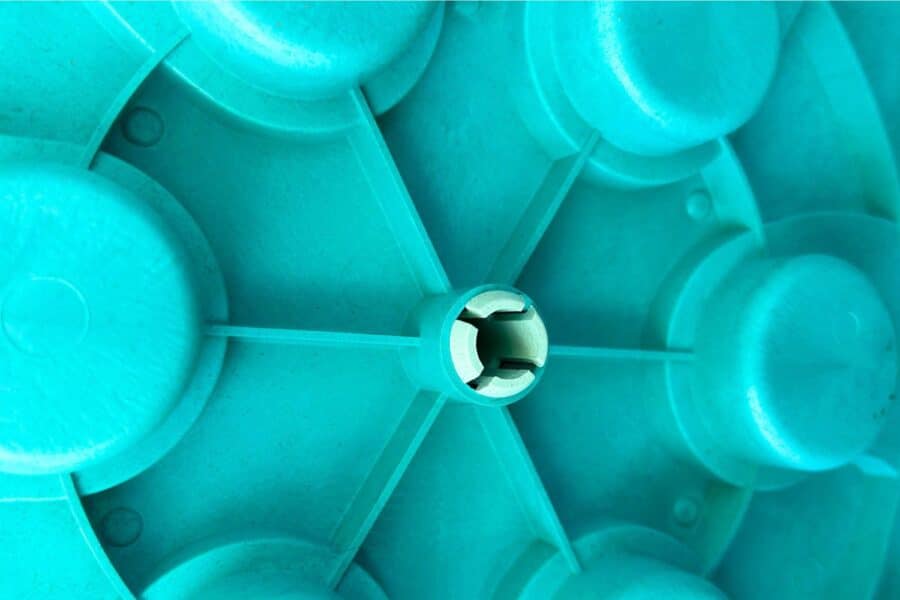
- Remove the center wheel. Flip the puzzle over and squeeze the center to release the wheel. You can return it for added difficulty later when your dog needs more challenge.
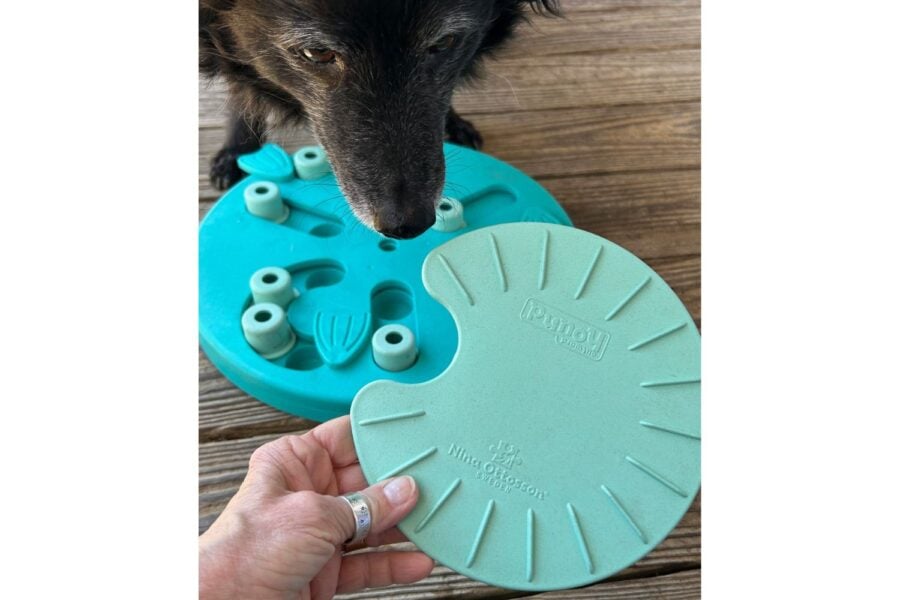
- Don’t put treats inside the moving blocks just yet. Those are the toughest to solve since they have to be moved over the recessed areas then moved out again to unveil the treat.
- Let your dog see you move the puzzle pieces and unveil some treats.
- Celebrate when your dog nudges or paws a piece — even if it’s accidental!
Gradually increase the complexity only when your dog is confidently solving the easier version.
Increase the Difficulty Level
Once your dog gets the hang of it, you can ramp up the challenge!
Add the Center Wheel. The wheel pops back into the puzzle and adds much more difficulty because the dog must line up the opening in the wheel with the block to then allow the recessed area to be unveiled.
Partially Cover Treats. If your dog doesn’t eat paper, you can wrap treats in thin paper (a paper towel or coffee filter) and put that into the recessed areas. Skip this tip if your dog eats paper!
Elevate the Puzzle. If your dog is speedy, move the puzzle to an elevated position like a dog table so your dog works the puzzle pieces with his nose, not his paws. This is also a great trick if your dog is being a little too rough with the puzzle!
Add More Challenges to Sliding. Make it tougher for your dog to slide the blocks by cutting up pieces of paper towel or toilet paper rolls and standing them in the channels. Your dog will need to remove these first before sliding the blocks.
Add Small Treats to the Sliding Blocks. The sliding blocks have to be positioned over the recessed areas–then moved back again–for the treat to be accessible.
How Does This Compare to the Hide ‘N Slide?
If you’re familiar with the many Nina Ottosson toys, you may have seen (or already have) the Hide ‘n Slide (my review), a very similar looking toy. I have had one for several years; I bought it used at a thrift store and it’s now on its second generation of dog play and still going strong!
The Hide ‘n Slide is considered a Level 2 or Intermediate puzzle, although you can increase the difficulty level of it and make it a Level 3 like the Dog Worker.
The Hide ‘n Slide doesn’t have the center wheel which makes the difficulty lower, although you can use some of the same tricks like putting treats inside the blocks or adding additional challenges such as pieces of toilet paper roll.
Pros
- A one-piece puzzle (unless you remove the center wheel). I love those because it’s easier to clean (and keeps me from losing any pieces!)
- Durable even when pawed.
- Versatile — works with kibble or treats.
- Food-safe.
- PVC free, BPA free, lead free and phthalate free.
Cons to Consider
- The wheel is a bit difficult to remove the first time. You’ll squeeze the back of the puzzle to release the wheel then it just pops back into place. On the plus side, this keeps your dog from removing the wheel himself!
- The wheel does really increase the difficulty level (and frustration level for your dog) so you need to monitor the toy and remove the wheel if you see your dog having too much difficulty.
- Some dogs may need your help at first–but think of it as a bonding experience.
Shop
This is not a sponsored post; I purchased the toys on my own and love using them with our dogs!
Pin it to Remember