
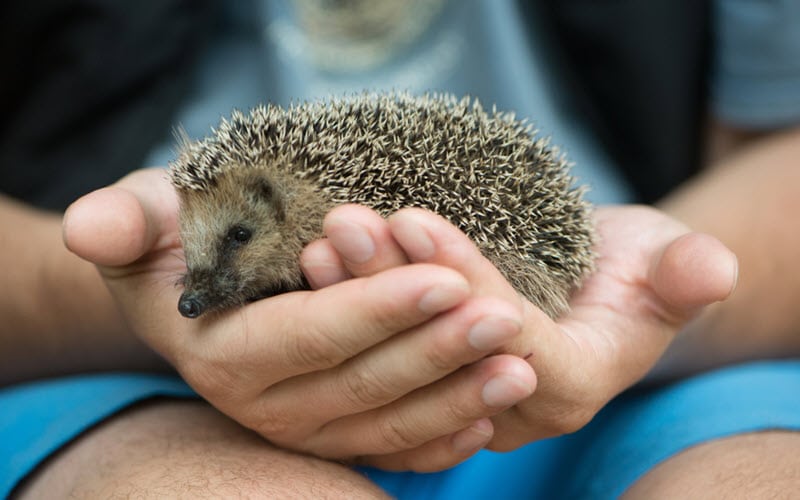
A pet African pygmy hedgehog needs a stable ambient temperature of 72 to 80 degrees Fahrenheit (22 to 27 Celsius) year-round, measured at cage-floor level, held by a thermostat-controlled ceramic heat emitter, with humidity under 40 percent and a 12-hour light and 12-hour dark cycle. Below roughly 65 degrees triggers life-threatening torpor; above roughly 85 degrees triggers heat stress.
Why temperature is the single most important husbandry parameter
Temperature is not a comfort setting for a pet hedgehog, it is a life-or-death husbandry parameter. The African pygmy hedgehog evolved in the warm, semi-arid grasslands of central and eastern Africa and never developed the endocrine or metabolic machinery that temperate-zone mammals use to survive cold winters or extended heat. When cage temperature drifts outside the narrow safe band, the consequences are immediate: torpor on the cold side, heat stress on the warm side, and a compromised immune system on either end.
The safe band across every major veterinary reference is tight. Merck Veterinary Manual specifies “Ambient temperature should be 72°–90°F (22°–32°C); 75°–85°F (24°–29°C) is optimal” and notes that “hedgehogs may go into a torpid state if they are too cool or too warm; this is believed to be unhealthy” (https://www.merckvetmanual.com/exotic-and-laboratory-animals/hedgehogs/management-of-hedgehogs). LafeberVet frames the target as 75 to 85 degrees Fahrenheit (24 to 30 Celsius) and states directly that “To prevent torpor, provide supplemental heating if temperature falls below 65°F (18°C)” and that keepers should “maintain weak or debilitated hedgehogs between 80-85°F (27-29°C)” (https://lafeber.com/vet/basic-information-for-hedgehogs/). University of Florida CVM names 70 to 80 degrees as the owner-facing working range (https://smallanimal.vethospital.ufl.edu/clinical-services/zoological-medicine/how-to-care-for-your-pet-hedgehog/). The pragmatic intersection experienced keepers hold year-round is 72 to 80 degrees at the cage floor, with 76 degrees as a forgiving midpoint that buffers drift in either direction.
The welfare math is unforgiving on both ends. An ambient drop under 65 to 68 degrees can push a captive hedgehog into torpor within hours, a hypothermic emergency that suppresses the immune system and can kill before morning. An ambient rise above about 85 degrees pushes the animal toward heat stress, a less-talked-about but equally real failure mode. From a rescue-intake perspective, the single most common preventable welfare issue we log in new-owner first-year vet visits is ambient drift below the safe band during shoulder seasons, usually because the keeper relied on a heat lamp without a thermostat or a heat pad without an animal-level thermometer. The heating stack and the thermometer placement are what separate “safe band held all year” from “emergency at 3 a.m.”
The safe band explained: 72 to 80 degrees Fahrenheit at the cage floor
The working target is 72 to 80 degrees Fahrenheit (22 to 27 Celsius) at the hedgehog’s level, year-round, with humidity under 40 percent and a 12-hour light and 12-hour dark cycle. That band is narrow by design, because both sides have hard welfare limits and the species does not tolerate prolonged drift.
The lower boundary sits at 72 degrees because ambient between 65 and 72 degrees begins to suppress activity, reduce appetite, and push the immune system toward the compromise state LafeberVet names. Below 65 to 68 degrees, torpor risk becomes acute and the window for avoiding an emergency shrinks to hours. Healthy adult hedgehogs vary in their individual threshold; some enter torpor at 68 degrees and others hold alert down to 64, but the safe margin is not a place to gamble. PetMD’s DVM-reviewed care sheet reinforces the point: below 65 degrees, hedgehogs become less active and the immune system is compromised (https://www.petmd.com/exotic/hedgehog-care-sheet). The upper boundary sits at 80 to 85 degrees because heat stress becomes a risk above that band and the animal has limited means to shed heat. For healthy adults, 80 is the working upper edge of normal.
Ill, thin, or debilitated animals need the upper end of the band, 80 to 85 degrees, while recovering. Hoglets under weaning age need the mother’s warmth plus cage ambient at or above 75. A hedgehog post-surgery or recovering from a torpor episode goes to 80 to 85 for 24 hours, then steps down to normal. Keepers new to the species can cross-check the hedgehog facts lifespan overview alongside the heating setup.
The year-round discipline is where many setups drift. Seasonal ambient shifts in most North American homes exceed 20 degrees between winter low and summer high, and a cage that reads 75 in October will read 64 in January and 86 in July if the keeper relies on house-ambient alone. A thermostat-controlled ceramic heat emitter takes winter off the risk list; a room AC and airflow management takes summer off the list. Both together convert temperature from “seasonal gamble” into “held setpoint.” For the broader ownership planning picture that sits around the heating-and-temperature layer, the hedgehog care guide hub connects the full husbandry stack together.
Why this range matters: torpor, heat stress, and semi-arid origin
The band is narrow because the African pygmy hedgehog’s native environment was narrow. Atelerix albiventris evolved in the semi-arid grasslands of West, Central, and East Africa, where overnight lows rarely drop below the upper-60s Fahrenheit and daytime highs sit in the upper-70s to mid-80s. The species never developed the brown-adipose-tissue reserves, hepatic-glycogen stores, or hormonal programming that temperate-zone mammals rely on to survive prolonged cold, and never developed efficient evaporative cooling for sustained heat. The broader hedgehog habitat background covers the wild-ancestry context; captive welfare depends on mimicking that narrow envelope indoors.
The cold-side failure mode is torpor. Below about 65 to 68 degrees, a captive hedgehog slows its heart rate and respiratory rate, the immune system is compromised, and body temperature can fall as low as 1 degree Celsius in extreme cases. The animal appears to be in deep sleep, but the physiological state is hypothermic emergency, not rest. Every clinical reference frames torpor as a state to prevent and to reverse promptly with gradual warming plus veterinary support. Recognition and the step-by-step rewarming protocol sit in the companion hedgehog hibernation and torpor guide; this article focuses on keeping torpor from ever starting.
The heat-side failure mode is heat stress. Above about 85 degrees, a hedgehog begins to sploot (lie flat with legs extended for cooler contact), pants through an open mouth (worth taking seriously in a species that normally nose-breathes), licks the belly compulsively, and eventually becomes lethargic and aggressive to handling. Merck frames the heat-side torpor as a real and unhealthy state. Heat stroke presents with rapid shallow breathing, bright red or very pale gums, disorientation, and warm-to-touch flank skin, and is a vet emergency. Transitional seasons are the overlooked risk window: spring and autumn present frequent day-night swings, and a winter-calibrated setup can overshoot on a warm spring afternoon while a summer setup can undershoot on a cool autumn night.
Heating hardware stack: CHE, thermostat, and why heat lamps lose
The heating stack that actually holds the safe band is a ceramic heat emitter paired with an external thermostat, backed by one or two digital thermometers at animal level. Everything else is either a supplementary tool or a hazard.
A ceramic heat emitter (CHE) is a heat-only bulb that screws into a clamp-lamp fixture rated for ceramic elements. It emits infrared heat with zero visible light, which is why it is the veterinary-standard choice for a nocturnal species whose circadian rhythm depends on a clean day-night cycle. Typical wattage runs 60 to 100 watts depending on cage size, room ambient, and insulation. A 60-watt CHE covers a 2 by 3 foot enclosure in a 68-degree room; a 100-watt unit handles a 4 by 2 foot enclosure in a cooler basement. Starting with a 100-watt CHE on a thermostat and letting the thermostat manage the duty cycle is the low-risk default.
A thermostat is non-negotiable. Plugging a CHE directly into the wall without one is among the most common preventable hardware failures in hedgehog husbandry, because an unregulated CHE will either cook the cage past 95 degrees on a warm day or undershoot on a cold one. A thermostat reads a probe placed at hedgehog level, cuts power when the setpoint is hit, and restores power below a hysteresis threshold. Keeper-community choices include the Herpstat, Vivarium Electronics VE-100 and VE-200, and the budget-priced Inkbird ITC-308; what matters is accuracy within about 1 degree and a proof-tested safety cutoff. Set the thermostat to hold 74 to 76 degrees with a 2-degree hysteresis, and the cage sits steady at 72 to 78 between cycles.
A deep heat projector (DHP) is an acceptable alternative emitting a broader infrared spectrum at lower wattage for the same ambient effect, but requires the same thermostat discipline. For a first build, CHE plus thermostat is the cheapest proven stack; DHP is an upgrade path.
An under-tank heater (UTH) or heat pad is supplementary only, never the sole heat source. UTHs create a warm spot the animal can move onto or off of, but do not hold ambient on their own. Direct-contact heating pads at high settings carry contact-burn risk for a hedgehog that cannot move away (a torpid or debilitated animal especially), so any heat pad sits under a portion of the enclosure floor, is thermostat-regulated, and is set low enough that an alert hedgehog chooses to lie on it.
Heat lamps with visible light (red, blue, or basking bulbs) are not recommended as primary heat. They add visible light at night, disrupting the nocturnal photoperiod and shortening active hours. They are acceptable only as emergency backup when no CHE is available. Space heaters managing the whole room are acceptable as backup during extreme cold snaps but on their own are insufficient, because room temperature and cage-floor temperature often differ by 5 to 8 degrees depending on drafts and cage placement. The full enclosure-and-accessory context around the heating stack lives in the hedgehog cage setup guide; this guide focuses on the temperature hardware specifically.
Thermometer placement: at cage floor, not cage ceiling or house wall
Placement decides whether the keeper reads what the animal actually experiences or a number that means nothing. The house thermostat in the living room is a rough reference only; the cage-floor thermometer is the source of truth.
The primary digital thermometer sits at the hedgehog’s level, which is the cage floor or the height of the sleeping hide, not the top of the cage and not on the cage wall above the wheel. Hot air rises and cold air settles, and a thermometer mounted at the cage ceiling can read 78 degrees while the cage floor reads 68. The probe on the thermostat and a separate digital thermometer both belong in the ambient zone, at animal height, away from direct line-of-sight of the CHE so they read ambient and not heat-source radiation. A secondary thermometer placed at the opposite corner confirms the temperature gradient is reasonable: a 3 to 4 degree difference between the warm end (under the CHE) and the cool end is healthy and gives the hedgehog a chosen comfort zone; a difference larger than 6 to 8 degrees means the warm end is overheating or the cool end is drafty.
Both thermometers should be digital with minimum and maximum memory. The single most valuable habit is checking and resetting the minimum-memory reading each morning in winter and the maximum-memory each afternoon in summer. That 10-second habit catches a thermostat drift, a blown CHE bulb, a dislodged probe, or an unexpectedly cold room overnight before the animal experiences consequences. Keepers who only read the current temperature when they happen to glance at the cage routinely miss overnight excursions and discover the pattern only after the first near-torpor event.
The delta between room reading and cage-floor reading can be substantial: a cage against a cold exterior wall in a 72-degree room can read 66 at the floor; a cage near an AC vent can read 68 in a 73-degree room; a basement corner can run 4 to 6 degrees cooler than the main-floor thermostat. After any setup change, re-verify cage-floor temperature for 24 to 48 hours against the minimum and maximum memory. A combined thermometer-hygrometer unit tracks humidity alongside, which matters because respiratory infection risk in this species correlates with both cold ambient and high humidity.
Humidity and photoperiod: the quiet parameters
Humidity and photoperiod are the two environmental variables that get less attention than temperature but quietly shape welfare over weeks and months.
Humidity targets sit below 40 percent per both Merck and LafeberVet. Too-high humidity (over 50 to 60 percent in a heated cage) raises the likelihood of bacterial respiratory infections and accelerates fungal growth in bedding. Too-low humidity (under 20 percent, common in heated homes during winter) dries skin, quills, and mucous membranes and feeds the dry-skin picture covered in the hedgehog bathing and grooming guide. Most indoor setups in the 72 to 80-degree range sit naturally at 25 to 45 percent, and a hygrometer on the cage confirms the band. A small dehumidifier handles persistent over-40-percent readings; a room humidifier at the lowest setting addresses persistent under-25-percent winter dryness.
Photoperiod targets 12 hours of light and 12 hours of dark, per Merck’s management chapter. Hedgehogs are crepuscular and nocturnal, and a stable day-night cycle drives appetite, wheel activity, and hormonal rhythms (the sleep-pattern detail sits in how long do hedgehogs sleep). No UVB is required for African pygmy hedgehogs. A timer-controlled room lamp on a 12-hour cycle handles photoperiod. Short day length (under 10 hours) can trigger seasonal torpor attempts even at otherwise-adequate temperature, which is why a photoperiod timer is cheap insurance against winter-triggered behavior change.
Cold-snap emergency protocol: when the heater fails
Equipment fails. Bulbs burn out, thermostats drift, power goes out, cords get unplugged during cleaning, probes fall out of place. When a cold-snap event hits, the first 30 minutes decide whether it becomes a near-miss or a torpor incident.
Step 1: verify cage-floor temperature. Read the primary thermometer and the minimum-memory. If the reading is at or below 68 degrees and the animal is alert, proceed. If the animal is already cold to the touch, limp, or unresponsive, switch to the emergency warming protocol in the companion torpor guide immediately.
Step 2: identify the failure. Is the CHE bulb lit (feel for heat near but not touching the fixture, since the CHE radiates noticeably even without visible light)? Is the thermostat display powered? Is the probe still in position at cage level? Is the room unusually cold from drafts, an open window, or HVAC off? Identify the single failure point before improvising a fix.
Step 3: restore heat. Replace a blown CHE bulb if a spare is available. If not, plug in a backup heater (a small space heater is the fastest interim), bundle the cage sides with a blanket to retain heat, and close doors to stabilize the room. Monitor the cage-floor thermometer every 5 to 10 minutes until it climbs into the 72 to 80 band.
Step 4: bundle the hedgehog for interim body-heat. If cage-floor reading is below 70 and the heat fix will take more than 15 minutes, move the alert hedgehog onto your body wrapped loosely in a pre-warmed dry towel, held against your chest under a shirt. Human body temperature matches the hedgehog’s normal body temperature closely and is a safe non-burning warming source. Individual tolerance varies; the cost of a 30-minute bundling session is zero compared to a torpor event.
Step 5: verify before releasing. Before returning the hedgehog to the cage, confirm the cage-floor thermometer is back to 74 to 76 degrees, the heat source is cycling normally, and the animal is alert. Watch for 30 to 60 minutes after return to confirm normal behavior.
Power-outage contingency. A battery-powered space heater or indoor-rated propane radiant heater holds room temperature during an outage. Air-activated hand warmers tucked into a towel around the carrier bridge short transports. A carrier pre-loaded with a fleece liner kept in a closet lets you move the hedgehog to a warmer location in under 5 minutes if the house cools fast.
Heat-wave emergency protocol: when summer threatens
The warm-side protocol is less familiar to most keepers but equally important during summer, power outages that knock out air conditioning, and apartments without independent climate control. Heat-stress signs to watch for include sustained splooting beyond a few minutes of normal mild-warmth behavior, open-mouth panting in a species that normally nose-breathes, bright red or very pale gums, compulsive belly-licking, lethargy, and a warm-to-touch flank. Sustained cage ambient above 85 degrees is the trigger to act.
The warm-side protocol:
Step 1: reduce cage ambient immediately. Turn off the CHE (or the thermostat), open the room to ventilation, turn on a fan pointed across the room (not directly at the cage), and verify the cage-floor thermometer is dropping. Target is back to 75 to 80 within 30 minutes.
Step 2: cool the enclosure without cold-shocking the animal. Wrap a frozen water bottle or reusable ice pack in a towel (two layers between ice and cage surface) and place it on top of the cage or against one exterior wall. Never place ice directly in the cage or against the hedgehog. A cool (not cold) ceramic tile placed inside the cage is a secondary option the hedgehog can choose.
Step 3: relocate if necessary. If cage ambient cannot be held under 85 despite fans and frozen bottles, move the carrier to the coolest room in the house, commonly a basement or tiled bathroom. Do not transfer the animal into a refrigerator, freezer, or direct-blowing AC stream. Offer fresh cool (not cold) water in the normal dish.
Step 4: vet escalation. Sustained panting more than 10 minutes after cooling begins, unresponsiveness, bright red or very pale gums, collapse, or bloody nose is an exotic-vet emergency. Heat stroke in hedgehogs progresses quickly and can kill within the same day; the broader vet-escalation pattern sits in the hedgehog health problems overview.
In our keeper community’s summer cooling surveys, the most common preventable heat-stress trigger is an apartment without air conditioning during a heatwave when the keeper is at work, paired with a CHE thermostat set at a winter setpoint that does not account for 90-degree room ambient. A thermostat that defaults the CHE off above 82 degrees, plus a fan on a separate timer, is cheap insurance for summer absence windows.
Travel and transport temperature
Short car rides and vet visits are the most common temperature-risk windows outside the home setup, and they get overlooked because they feel routine. A carrier in a cold winter car can lose cage-floor warmth in under 10 minutes; a carrier in a parked summer car can overheat in 5 minutes.
Working travel rules: warm the car to 72 to 80 before the hedgehog is brought out; use a carrier with a fleece liner and a hide; in cold weather, add a towel-wrapped warm water bottle or a chemical hand warmer tucked into the carrier wall outside the hedgehog’s direct contact; in hot weather, use AC during the drive and keep the carrier shaded. Never leave the carrier in a parked car. For long travel over 2 hours, a portable battery-powered CHE or a heat-pack rated for 8 to 12 hours is worth the cost. The calm hedgehog handling approach reduces stress response during any temperature-sensitive transport window.
Prevention: the four-control setup that keeps temperature off the risk list
Prevention rests on four controls in the order they matter:
Control 1: the safe band itself. Set a cage-floor target of 74 to 76 degrees as the thermostat setpoint, which buffers drift and keeps the animal in the comfortable middle of 72 to 80 year-round.
Control 2: thermostat-controlled ceramic heat emitter as the primary source. CHE plus thermostat plus proper fixture is the veterinary-standard stack. A DHP is an acceptable higher-cost alternative. Everything else is secondary.
Control 3: digital thermometer at animal level with minimum-maximum memory. Placed at cage floor in the ambient zone, checked daily in cold and hot months, reset after each reading to catch the next excursion.
Control 4: seasonal-vigilance habit. A pre-winter check every late September (CHE bulb replacement, thermostat probe inspection, backup thermometer calibration, emergency-warming rehearsal) and a pre-summer check every late May (AC confirmation, fan placement, cooling protocol mental-rehearsal). Experienced keepers we work with typically catch equipment drift through the weekly habit of glancing at the minimum-memory reading when they refresh water, which costs nothing and converts torpor risk from “surprise emergency” into “caught at routine check.”
After any cage move, room reshuffle, HVAC service call, or seasonal HVAC mode switch, re-verify cage-floor temperature for 24 to 48 hours. The cost of extra thermometer reading is zero; the cost of an unexpected draft from a newly-reopened AC vent cooling the cage overnight is potentially a torpor event.
Frequently asked questions
What temperature do hedgehogs need?
Pet African pygmy hedgehogs need a stable ambient temperature of 72 to 80 degrees Fahrenheit (22 to 27 Celsius) at cage-floor level, year-round. Merck Veterinary Manual names 72 to 90 degrees with 75 to 85 optimal, and LafeberVet specifies 75 to 85 degrees with supplemental heating if ambient falls below 65. The pragmatic working target experienced keepers hold is 74 to 76 as a thermostat setpoint, buffering drift in either direction. Ill or debilitated hedgehogs need the upper end, 80 to 85 degrees, while recovering.
Do hedgehogs need a heat lamp?
No, not a visible-light heat lamp. The veterinary-standard heat source is a ceramic heat emitter (CHE), a heat-only bulb that produces no visible light, paired with an external thermostat. Heat lamps that emit visible light disrupt the nocturnal photoperiod and can shorten active hours or trigger circadian stress. A CHE plus thermostat holds 72 to 80 degrees at cage floor reliably, while a deep heat projector (DHP) is an acceptable higher-cost alternative. Heat pads are supplementary only, never the sole heat source.
What happens if a hedgehog gets too cold?
Below about 65 to 68 degrees Fahrenheit, a captive hedgehog risks entering torpor, a hypothermic emergency that suppresses the immune system, drops heart and respiratory rates, and can kill within hours. Captive African pygmy hedgehogs never developed the physiology to hibernate safely. Signs include cold belly, inability to ball up, slow or shallow breathing, and minimal response to touch. The warming protocol is covered in the companion torpor guide; prevention via a stable 72 to 80 degree band is the goal.
What happens if a hedgehog gets too hot?
Above about 85 degrees Fahrenheit, hedgehogs risk heat stress. Signs include sustained splooting with lethargy, open-mouth panting in a species that normally nose-breathes, compulsive belly-licking, bright red or very pale gums, and eventually collapse. Merck notes that both too-cold and very-high temperatures can induce unhealthy torpor. Reduce cage ambient immediately using fans, frozen bottles wrapped in towels placed outside the cage, cool water in the dish, and a move to a cooler room if needed. Sustained panting or unresponsiveness is an exotic-vet emergency.
Why is a thermostat required on the ceramic heat emitter?
A ceramic heat emitter without a thermostat has no feedback loop and will overheat the cage on warm days or undershoot on cold ones. An unthermostated CHE is a common preventable cause of heat stress in this species and a frequent trigger for fire-safety calls in exotic-pet keeping. A thermostat reads a probe at hedgehog level, cuts power when the setpoint is hit, and restores below a hysteresis threshold. Quality thermostats (Herpstat, VE-200, Inkbird ITC-308) hold within about 1 degree of setpoint reliably.
Where should the thermometer go in a hedgehog cage?
The primary digital thermometer goes at hedgehog level, which is the cage floor or the height of the sleeping hide, placed in the ambient zone and not directly under the CHE. A secondary thermometer at the opposite corner confirms the temperature gradient is reasonable (a 3 to 4 degree difference between warm and cool ends is healthy). Both should be digital with minimum and maximum memory, and the keeper resets the memory each morning in cold months to catch overnight excursions. A combined thermometer-hygrometer unit also tracks humidity.
What humidity do hedgehogs need?
Humidity below 40 percent is preferred per both Merck Veterinary Manual and LafeberVet. Too-high humidity (over 50 to 60 percent in a heated cage) increases respiratory infection risk and accelerates fungal growth in bedding. Too-low humidity (under 20 percent, common in heated winter homes) dries skin, quills, and mucous membranes. Most indoor setups in the 72 to 80 degree range sit naturally between 25 and 45 percent, and a hygrometer on the cage confirms the band. Adjust with a small dehumidifier or a room humidifier on the lowest setting.
How do I handle a winter power outage with a hedgehog?
Pre-plan before winter. Keep a battery-powered space heater or indoor-rated propane radiant heater on hand, plus air-activated hand warmers and a pre-loaded carrier with a fleece liner. During an outage, close the cage room to conserve heat, bundle the cage sides with blankets, move the alert hedgehog onto your body wrapped in a pre-warmed towel under your shirt if cage ambient drops below 70 for more than 15 minutes, and plan evacuation to a warmer location if the outage looks long. Never use unvented gas appliances indoors.
Researched and written by the ExoPetGuides editorial team with AI-assisted drafting. All husbandry parameters and veterinary references independently verified against the Merck Veterinary Manual hedgehog management chapter (Doss DVM DACZM and Carpenter DVM DACZM), the LafeberVet Basic Information Sheet for the African pygmy hedgehog (Pollock DVM DABVP and Parmentier DVM), the University of Florida College of Veterinary Medicine Zoological Medicine hedgehog care page, the PetMD hedgehog care sheet (Witherell DVM, reviewed by Morrison DVM), and Hedgehog Welfare Society published keeper resources.
Disclaimer: This content is for educational purposes only and is not a substitute for professional veterinary advice. Always consult a qualified veterinarian — ideally an exotic-animal specialist — for any health concern about your pet. Care recommendations may vary based on species, individual animal, and local regulations.