Researched and written by the ExoPetGuides editorial team with AI-assisted drafting. All husbandry parameters and veterinary references independently verified.
How Jumping Spiders Drink Water
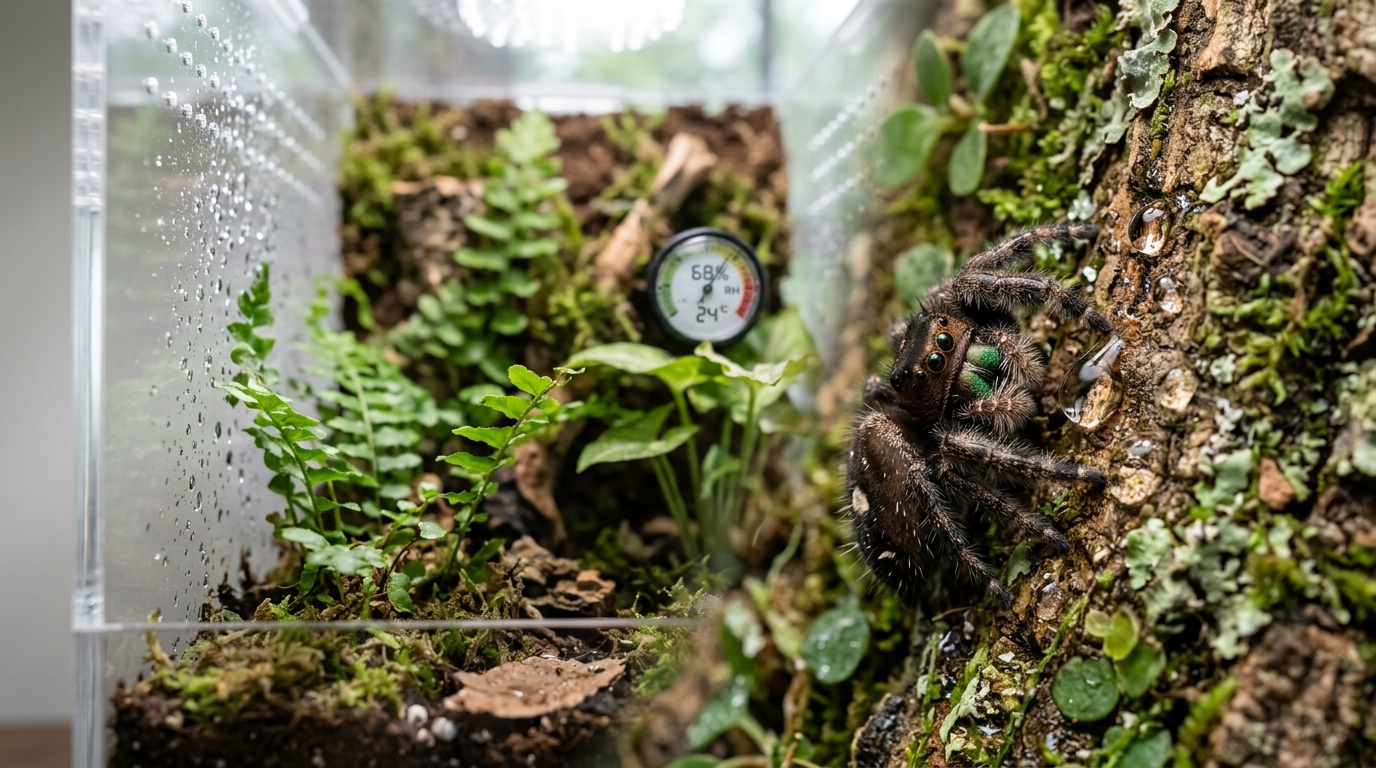
Jumping spiders do not drink from standing water the way mammals or reptiles do. They drink individual water droplets that form on enclosure surfaces after misting. In the wild, Salticidae species obtain moisture from morning dew, rain droplets on leaves, and the body fluids of their prey (source: Journal of Arachnology). In captivity, this means your primary hydration tool is a fine-mist spray bottle, not a water dish.
When a jumping spider locates a water droplet, it presses its chelicerae (mouthparts) directly against the droplet and draws water in through capillary action. You can often observe this behavior shortly after misting, particularly if the spider has been active and hunting. Spiders that are well-hydrated tend to have plump, rounded abdomens, while dehydrated individuals develop a visibly shrunken or wrinkled abdomen.
Hydration is one of the most overlooked aspects of jumping spider care. Most health problems that keepers attribute to diet or temperature actually trace back to insufficient moisture. If your enclosure setup needs a refresh, the jumping spider enclosure setup guide covers ventilation and layout fundamentals that directly affect humidity retention.
Misting: Technique, Frequency, and Common Mistakes
Misting is the standard hydration method for captive jumping spiders. The goal is to create small water droplets on enclosure walls and decorations without flooding the substrate or saturating the enclosure.
How to mist correctly:
- Use a clean, fine-mist spray bottle. Avoid bottles that produce large streams or heavy droplets.
- Spray 2-4 light pumps onto the walls and decorations of the enclosure, not directly onto the spider.
- Target one corner or one wall section. This creates a “wet zone” where the spider can drink while the rest of the enclosure stays drier.
- Mist once every 1-2 days for most species. In drier climates or heated rooms, daily misting may be necessary.
- Mist in the morning or early afternoon when jumping spiders are most active and likely to find and drink the droplets.
Common misting mistakes:
| Mistake | Why it matters | Fix |
|---|---|---|
| Over-misting the entire enclosure | Creates stagnant moisture, promotes mold and bacterial growth | Mist one corner only; let the rest stay dry |
| Spraying directly onto the spider | Startles the spider and can damage silk retreats | Aim at walls and decor, not the animal |
| Using tap water with high chlorine | Chlorine residue can irritate a spider’s book lungs over time | Use dechlorinated water or let tap water sit for 24 hours |
| Misting at night | Spider is in its silk retreat and unlikely to drink; moisture sits without evaporating | Mist during daytime active hours |
| Skipping misting because “the enclosure looks fine” | Dehydration develops before visible enclosure dryness | Maintain a consistent schedule regardless of appearance |
The droplets should evaporate within a few hours. If water pools on the substrate or lingers on walls past the 6-hour mark, your ventilation is insufficient. Cross-ventilation (vents on opposite sides of the enclosure) is the standard solution. For species-specific enclosure adjustments, see the regal jumping spider care guide.
Water Dishes: Do Jumping Spiders Need Them?
Water dishes are not standard equipment for jumping spider enclosures, and many experienced keepers advise against them entirely. The reasons are practical:
- Jumping spiders are small enough to drown in even shallow water. A sling (spiderling) can drown in a bottle cap of water.
- Standing water promotes bacterial growth and mold in the warm, enclosed environment of a terrarium.
- Jumping spiders rarely recognize standing water as a drinking source. They evolved to drink dew droplets, not pools.
If you want to provide a secondary water source alongside misting, a safer option is a small piece of damp cotton or sphagnum moss placed in one corner of the enclosure. The spider can press against the damp material to absorb moisture without any drowning risk. Replace the cotton or moss every 2-3 days to prevent bacterial buildup.
Some keepers of larger species like Hyllus diardi use a tiny, shallow water dish (less than 5 mm deep) with a piece of cotton or paper towel draped over the edge to act as a ramp. This can work for adult specimens but should never be used for slings or juveniles. For more on Hyllus-specific humidity needs, see the Hyllus diardi care guide.
Humidity Levels for Jumping Spiders
Jumping spiders are not tropical humidity-dependent species. Most pet species (Phidippus regius, P. audax, Hasarius adansoni) thrive at 50-60% ambient humidity with occasional misting (source: PetMD Jumping Spider Care). This is lower than what many reptile and amphibian species require, and over-humidifying a jumping spider enclosure is a more common problem than under-humidifying.
Target humidity ranges by species group:
| Species group | Ambient humidity | Misting frequency | Notes |
|---|---|---|---|
| Phidippus regius (regal) | 50-60% | Every 1-2 days | Most forgiving of dry conditions |
| Phidippus audax (bold) | 50-60% | Every 1-2 days | Similar to regius |
| Hyllus diardi (heavy jumper) | 60-70% | Daily | Subtropical species; needs higher baseline |
| Hasarius adansoni (adanson’s) | 50-60% | Every 1-2 days | Adaptable; common household conditions often sufficient |
| Maratus spp. (peacock) | 40-55% | Every 2-3 days | Arid-origin species; easily over-humidified |
Measuring humidity: A small digital hygrometer placed inside the enclosure gives you an accurate reading. Analog hygrometers are unreliable at the scale of a jumping spider terrarium. Check the reading 1-2 hours after misting to see the peak, and again 6-8 hours later to confirm it drops back to baseline.
Ventilation and humidity work as a pair. An enclosure with no ventilation will trap moisture and climb to dangerous levels (above 70% sustained), promoting mold and respiratory stress. An enclosure with too much ventilation (fully mesh-topped, no solid panels) will drop humidity faster than misting can replace it. The standard setup is a front-opening acrylic or glass enclosure with cross-ventilation holes on two sides. For detailed enclosure ventilation guidance, see the temperature and humidity guide.
Signs of Dehydration in Jumping Spiders
Dehydration is one of the leading causes of premature death in captive jumping spiders, particularly slings and juveniles. It develops quickly because of the spider’s small body mass and high surface-area-to-volume ratio. Recognizing the signs early gives you the best chance of correcting the problem before it becomes critical.
Early dehydration signs:
- Shrunken or wrinkled abdomen. A healthy jumping spider’s abdomen is plump and rounded. A dehydrated spider’s abdomen appears deflated, with visible wrinkling or creasing on the dorsal (top) surface.
- Reduced activity. Dehydrated spiders become lethargic, spending more time in their silk retreat and less time exploring or hunting.
- Reluctance to eat. A mildly dehydrated spider may ignore prey that it would normally pounce on immediately.
Advanced dehydration signs:
- Legs curling inward. Jumping spiders use hydraulic pressure (hemolymph) to extend their legs. Severe dehydration reduces hemolymph volume, causing the legs to curl under the body.
- Inability to jump. If a jumping spider cannot jump or repeatedly falls short of targets, dehydration is a likely cause.
- Unresponsiveness. A severely dehydrated spider may sit motionless for extended periods and fail to react to movement or vibration nearby.
Emergency hydration protocol:
If you suspect severe dehydration, do the following immediately:
- Mist the enclosure lightly, placing several small droplets directly in front of the spider (not on the spider itself).
- If the spider does not drink from droplets within 30 minutes, place a small damp cotton ball or piece of wet paper towel touching the spider’s front legs. This allows passive moisture absorption.
- Raise the enclosure humidity to 65-70% temporarily by misting more heavily and partially covering ventilation holes with damp paper towel.
- Do not offer food until the spider has rehydrated. Digestion requires body water, and feeding a dehydrated spider can worsen the condition.
- If the spider shows no improvement within 24 hours, the situation is critical. Consult an exotic veterinarian experienced with invertebrates.
Dehydration symptoms overlap with pre-molt behavior (reduced activity, food refusal, hiding). The key difference is the abdomen: a pre-molt spider typically has a dark, swollen abdomen, while a dehydrated spider has a shrunken, wrinkled one. For more on distinguishing these states, see the jumping spider molting guide.
Hydration Needs by Life Stage
Slings, juveniles, and adults have different hydration requirements due to their body size and metabolic rate.
Slings (Spiderlings)
Slings are the most vulnerable to dehydration. Their tiny body mass means they lose moisture rapidly, and even a single missed misting day can be dangerous in low-humidity environments.
- Mist the sling enclosure (typically a deli cup with ventilation holes) lightly every day.
- Place a single small droplet near the sling rather than spraying the entire container.
- Never leave standing water in a sling container. Slings can drown in water volumes too small for you to notice.
- If humidity in your home is consistently below 40%, consider adding a tiny piece of damp sphagnum moss to one corner of the container.
Juveniles
Juveniles are more resilient than slings but still require consistent misting.
- Mist every 1-2 days depending on ambient conditions.
- By this stage, the spider will actively seek out and drink water droplets on its own.
- Monitor abdomen condition weekly. A juvenile with a consistently plump abdomen is well-hydrated.
Adults
Adults tolerate brief dry periods better than younger spiders, but consistent hydration remains important for long-term health and breeding condition.
- Mist every 1-2 days.
- Adults approaching a molt may drink more frequently. If you notice increased drinking behavior, ensure misting is daily until the molt completes.
- Female spiders guarding egg sacs need reliable hydration because they typically do not leave the sac to hunt or drink. Mist near the retreat entrance so she can access water without abandoning her eggs.
For a complete growth-stage care reference, see the jumping spider spiderling care guide.
Water Quality for Jumping Spiders
The water you use for misting matters more than most keepers realize. Jumping spiders have book lungs, respiratory organs that are sensitive to airborne and surface-deposited chemicals.
Recommended water types:
- Dechlorinated tap water: Let tap water sit in an open container for 24 hours to off-gas chlorine, or use a water conditioner designed for aquarium use.
- Filtered water: Carbon-filtered or reverse-osmosis water works well. Avoid distilled water long-term because it lacks trace minerals.
- Spring water: Bottled spring water is a convenient option, though not necessary if your tap water is treated.
Water to avoid:
- Untreated tap water with high chlorine or chloramine content.
- Water from a softener system (high sodium content).
- Any water that has been stored in containers previously used for cleaning products or chemicals.
Frequently Asked Questions
How often should I mist my jumping spider enclosure?
Every 1-2 days for most species. In dry climates, heated rooms, or during winter when indoor humidity drops, daily misting is advisable. Sling enclosures should be misted daily regardless of conditions. The goal is consistent access to drinking droplets, not a perpetually wet enclosure.
Can jumping spiders drown?
Yes. Jumping spiders, especially slings, can drown in small volumes of standing water. A bottle cap filled with water is deep enough to be lethal for a spiderling. This is why misting (creating small, surface-adhered droplets) is preferred over water dishes. If you do use a water source, ensure the spider can easily climb out.
What humidity should I keep for a jumping spider?
Most pet jumping spider species thrive at 50-60% ambient humidity. Subtropical species like Hyllus diardi prefer 60-70%. Humidity should spike briefly after misting and return to baseline within a few hours. Sustained humidity above 70% promotes mold growth and respiratory stress.
How can I tell if my jumping spider is dehydrated?
The clearest indicator is the abdomen. A dehydrated jumping spider has a visibly shrunken, wrinkled, or deflated abdomen compared to the plump, rounded abdomen of a well-hydrated individual. Other signs include lethargy, reluctance to eat, inability to jump, and legs curling inward.
Is tap water safe for jumping spiders?
Tap water is safe if you remove the chlorine first. Let it sit in an open container for 24 hours or treat it with an aquarium water conditioner. Avoid water from softener systems or water stored in chemical containers.
Should I spray water directly on my jumping spider?
No. Direct spraying startles the spider, can damage its silk retreat, and forces water into the book lungs, which can cause respiratory distress. Always spray walls, decorations, and enclosure surfaces near the spider rather than the spider itself.
Researched and written by the ExoPetGuides editorial team with AI-assisted drafting. All husbandry parameters and veterinary references independently verified against peer-reviewed sources.
Sources
Editorial Disclosure
This article was researched and written by the ExoPetGuides editorial team with AI-assisted drafting. All husbandry parameters and care recommendations were independently verified against species authorities and keeper literature. ExoPetGuides does not sell spider care products and has no affiliate relationship with any brand mentioned in this article.
This guide provides general husbandry information based on current species-authority consensus. It is not a substitute for professional veterinary advice. If your jumping spider shows signs of severe dehydration or illness, consult a qualified exotic veterinarian experienced with invertebrates.


![Sick Axolotl, Fungus, Stress Symptoms [Axolotl Illness Guide 2025]](https://petsforchildren.com/wp-content/uploads/2026/03/sick-axolotl-fungus-stress-symptoms-axolotl-illness-guide-2025-370x297.jpg "Sick Axolotl, Fungus, Stress Symptoms [Axolotl Illness Guide 2025]")