
Researched and written by the ExoPetGuides editorial team with AI-assisted drafting. All husbandry parameters and veterinary references independently verified.
This article is not a substitute for professional veterinary advice.
Why Sexing Your Jumping Spider Matters
Knowing whether your jumping spider is male or female affects every aspect of care planning. Males and females differ in lifespan, size, temperament, and feeding requirements. Males live shorter lives (often 6 to 12 months as adults compared to 1 to 2 years for females), display more active roaming behavior, and are the sex used in breeding introductions. Females grow larger, live longer, and are the ones that produce egg sacs.
If you plan to breed, accurate sexing is a prerequisite. If you keep jumping spiders as display pets, knowing the sex helps you set expectations for adult size, coloration, and longevity. The breeding guide covers the next steps once you have confirmed a mature pair.
The Primary Method: Pedipalp Shape
Pedipalps are the small appendages flanking the chelicerae (fangs) at the front of the spider’s body. They are the single most reliable sex indicator in jumping spiders across all commonly kept species.
Male Pedipalps
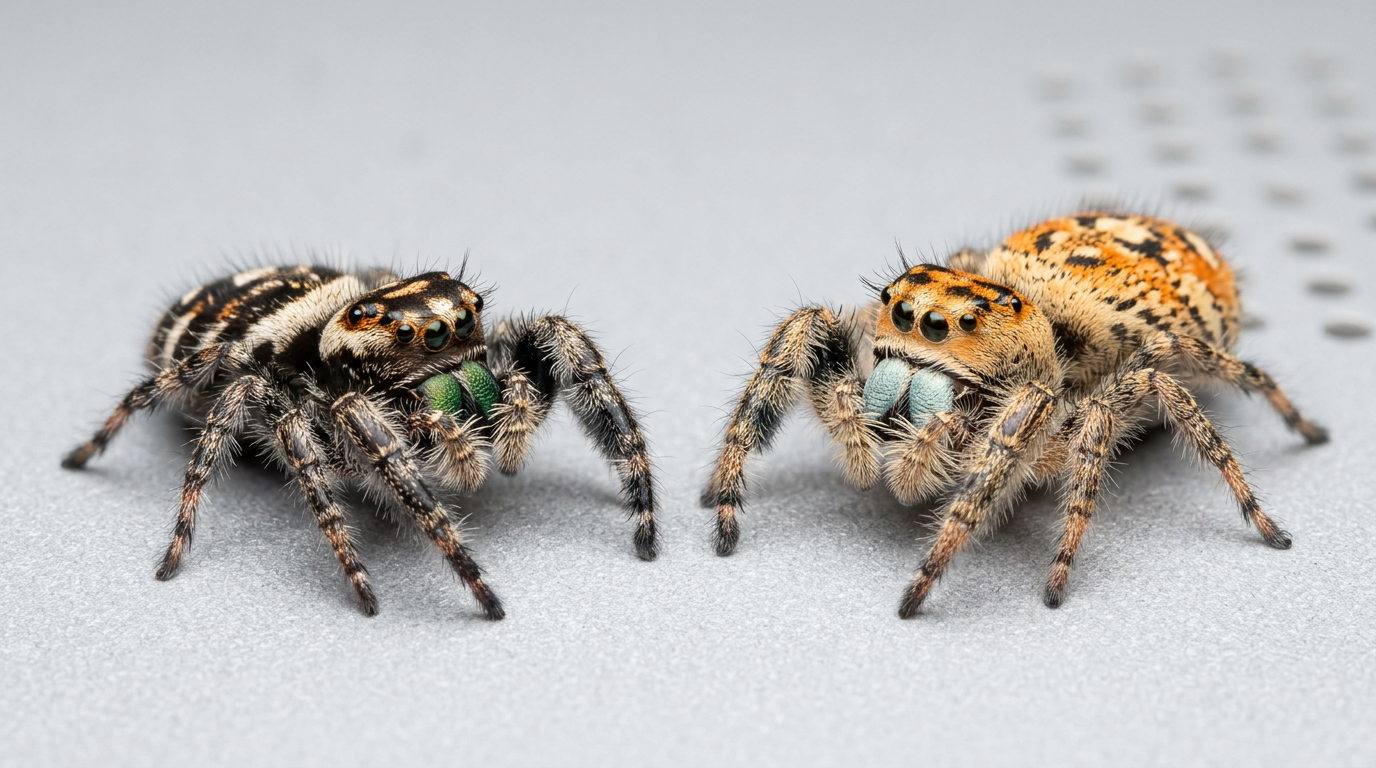
Mature males have visibly enlarged, bulbous pedipalp tips. These swollen tips (called palpal bulbs or emboli) function as sperm transfer organs. They look like tiny boxing gloves or clubs at the end of each pedipalp. The bulbous shape is unmistakable in mature males and develops fully after the final molt.
Sub-adult males (one molt away from maturity) may show slightly swollen pedipalp tips, but the bulbs are not fully expanded. If the pedipalps appear slightly thicker than expected but not yet club-shaped, the spider is likely a penultimate male.
Female Pedipalps
Female pedipalps remain slender and leg-like throughout their lives. The tips are not enlarged and function primarily as sensory organs rather than reproductive structures. If the pedipalps look like miniature front legs with no swelling at the tips, the spider is female.
Checking Pedipalps in Practice
The easiest way to observe pedipalps is when the spider is on a clear surface, such as the wall of an acrylic enclosure or a glass sheet. A magnifying glass or macro lens on a phone camera helps, especially for smaller species. Look at the spider from the front or slightly below. The difference between male and female pedipalp shape is visible to the naked eye in adults of larger species like Phidippus regius (source: BugGuide – Salticidae identification).
Secondary Method: Body Size and Proportions
Sexual dimorphism in body size is pronounced in most pet jumping spider species. However, size alone is not a reliable sexing method because it depends on age, feeding history, and species.
General Size Patterns
| Trait | Males | Females |
|---|---|---|
| Body length (Phidippus regius adult) | 10 to 15 mm | 15 to 22 mm |
| Abdomen shape | Slender, elongated | Rounder, broader (especially when gravid) |
| Leg span relative to body | Proportionally longer legs | Proportionally shorter, sturdier legs |
| Overall build | Leaner, more agile appearance | Heavier, more robust appearance |
Females are almost always larger than males of the same species at full maturity. A fully grown male P. regius is noticeably smaller than a fully grown female, even when both are well-fed.
Coloration and Markings
In many jumping spider species, males and females display distinct coloration patterns. This is one of the more accessible identification methods for beginners, though it varies significantly by species.
Phidippus regius (Regal Jumping Spider)
- Males: Black body with white markings on the abdomen and legs. Chelicerae (fangs) often display iridescent green or blue-green coloration. More contrast between dark and light areas.
- Females: Lighter overall, often tan, gray, or orange-brown with white or cream markings. Less contrast and more muted tones. Chelicerae are typically dark without strong iridescence.
Phidippus audax (Bold Jumping Spider)
- Males: Black body with a central white or orange spot on the dorsal abdomen. Chelicerae show bright, iridescent green.
- Females: Similar pattern but often with slightly less vivid chelicera coloration. Size difference is more diagnostic than color in this species.
Hyllus diardi (Heavy Jumping Spider)
- Males: More contrasting black-and-white markings. Prominent white “mustache” markings near the chelicerae.
- Females: Brown or gray overall with less defined markings.
Species-specific coloration differences are covered in the individual care guides for regal jumping spiders and bold jumping spiders.
Important caveat: Juvenile jumping spiders of both sexes often look similar in color. Reliable color-based sexing typically requires the spider to be at sub-adult stage or older.
Behavioral Differences Between Males and Females
Behavioral observation is a supporting method, not a primary one. The behaviors described below are tendencies, not guarantees.
Male Behavior Patterns
- Active roaming: Mature males spend more time exploring the enclosure, pacing walls, and attempting to find mates. This wandering behavior intensifies after the final molt.
- Courtship displays: Males will sometimes perform courtship dances even without a female present, waving their front legs and pedipalps at their own reflection or at the keeper.
- Reduced interest in food: Mature males often eat less than females, prioritizing mate-seeking over feeding.
Female Behavior Patterns
- Web construction: Females tend to build larger, more elaborate silk retreats and spend more time in or near them.
- Consistent feeding: Females maintain a regular appetite throughout their adult lives (except during pre-molt and egg-guarding periods).
- Territorial stability: Females are less restless than males and tend to establish a home base within the enclosure.
The behavior guide covers a broader range of jumping spider body language and activity patterns.
Sexing Juvenile and Sub-Adult Spiders
Sexing young jumping spiders is more difficult than sexing adults because the primary indicators (pedipalp shape, coloration, size) have not fully developed. However, there are methods that experienced keepers use:
Ventral Examination (Epigynal Fold)
In sub-adult and adult females, a small, sclerotized plate called the epigyne is visible on the underside of the abdomen, just in front of the book lungs. This structure receives the male’s pedipalp during mating. Males do not have an epigyne.
Examining the ventral abdomen requires either a clear-bottomed enclosure or carefully positioning the spider on glass. A macro lens or jeweler’s loupe (10x to 20x magnification) is helpful. This method becomes reliable at the penultimate molt stage.
Molt Examination
Examining a shed exoskeleton (exuvium) under magnification is the most reliable method for sexing sub-adult spiders. The exuvium preserves the structure of the epigynal region (in females) or the developing pedipalp bulbs (in males). This technique requires a magnifying tool and a well-preserved molt.
To preserve a molt for examination: remove it from the enclosure carefully using fine tweezers, place it in a small dish, and gently unfold the abdomen region using a dampened toothpick. Look at the ventral surface of the abdomen near the front (source: American Arachnological Society – Spider morphology).
Common Sexing Mistakes
Assuming Color Equals Sex in Juveniles
Juvenile jumping spiders of both sexes frequently display similar coloration. A juvenile with bright chelicerae is not necessarily male, and a dull-colored juvenile is not necessarily female. Wait until at least the penultimate molt for color-based sexing to be meaningful.
Confusing Pedipalps with Front Legs
In species with relatively slender pedipalps (like some Hasarius or Maratus species), the pedipalps can be less visually distinct. If you are unsure, compare the appendages directly flanking the chelicerae (pedipalps) to the first pair of walking legs. Pedipalps are shorter and positioned differently.
Relying on a Single Indicator
No single method is 100% reliable before maturity. The most confident sexing combines pedipalp shape, ventral examination, and coloration together. If two out of three indicators agree, you can be reasonably confident.
Quick Reference: Male vs Female Identification Summary
| Feature | Male | Female |
|---|---|---|
| Pedipalps | Bulbous, club-shaped tips (mature) | Slender, leg-like |
| Body size | Smaller at maturity | Larger at maturity |
| Abdomen | Slender, elongated | Rounder, broader |
| Coloration (most species) | Higher contrast, iridescent chelicerae | Muted tones, less contrast |
| Epigyne (ventral abdomen) | Absent | Present (sclerotized plate) |
| Behavior | Restless, roaming, courtship displays | Settled, consistent feeding, elaborate retreats |
| Lifespan | Shorter (6 to 12 months as adult) | Longer (1 to 2 years as adult) |
Frequently Asked Questions
At what age can you reliably sex a jumping spider?
For most Phidippus species, sexing becomes reliable at the penultimate (second-to-last) molt, typically around three to four months of age. Pedipalp swelling in males begins to show at this stage, and the epigynal fold becomes visible in females. Before this, sexing is speculative.
Can you sex jumping spiders from photos?
Yes, in many cases. A clear photo of the spider from the front (showing pedipalps) or a dorsal view (showing coloration patterns) is often sufficient for experienced keepers to determine sex in sub-adult and adult spiders. Many jumping spider communities on Facebook and Reddit offer free photo-based sexing assistance.
Does the sex of my jumping spider affect enclosure requirements?
Not significantly for housing purposes. Males and females of the same species and size can use the same enclosure dimensions. The main practical difference is that females need a suitable space to build an egg sac retreat if they have been mated, and males may be more persistent in trying to escape to find mates.
Do male jumping spiders really die sooner than females?
Yes. In virtually all pet jumping spider species, males have shorter lifespans than females. A male Phidippus regius may live 6 to 12 months after his final molt, while a female of the same species can live 1 to 2 years after reaching maturity. This is a biological constant, not a husbandry failure. The lifespan guide covers longevity factors in detail.
I bought a jumping spider labeled as female but I think it might be male. What should I do?
Check the pedipalps. If the tips are bulbous and club-shaped, the spider is male regardless of what the seller labeled it. Mislabeling is common, especially when spiders are sold at younger instars before sexual dimorphism is fully expressed. This is not necessarily dishonest on the seller’s part, as sexing young slings is genuinely difficult.